Saturday, May 4, 2013

From the Library of the Walt Disney Studio

When I saw the card paper-clipped inside the old Holiday magazine at the estate sale, it took me a minute to realize what I was looking at.


At first I thought the magazine must have been part of a public library's collection.  But why would it be available for check-out?  And why would the check-out dates span almost 20 years?

Then I noticed the front of the magazine:


"Library of the Walt Disney Studios," the stamp read.   So the people who signed the library check-out card, must have been Disney employees.  That got me started on a quest to find out what some of these people did for Disney, in the 1940s through 1960s.

Yale Gracey was the first to check out the magazine.  He was a writer, a layout artist and later an Imagineer for Disney.  He worked on The Three Caballeros and Fantasia, and designed many of the special effects for the Disneyland rides Haunted Mansion and Pirates of the Caribbean. 

Milt Schaffer worked as a writer on more than 100 different titles for Disney and other companies.  Among his credits are some of my favorite Disney animated shorts, including many that starred Chip 'n' Dale.

George Goepper worked for Disney and later Hanna-Barbera as an animator.  His career spanned The Reluctant Dragon and Bambi (early 1940s) and Paul Bunyan (1958) at Disney, to classic TV cartoons including The Flintstones, The Jetsons, Hey There, It's Yogi Bear, Magilla Gorilla, Jonny Quest, Secret Squirrel [are the theme songs running through your head yet?], Moby Dick and the Mighty Mightor, The Perils of Penelope Pitstop, Cattanooga Cats, Scooby Doo, Where Are You!, Where's Huddles? and more. 

Freeman Butts worked at Disney as a young man, then later relocated to Montana, where he was revered both as a landscape artist and as a community member.

Dorothy Esgate was an ink-and-painter at Disney from 1937 until her retirement in 1977.

John Mansbridge began his career as a draftsman on Orson Welles' Citizen Kane in 1942.  He was Art Director for many episodes of the TV classic The Adventures of Superman, then  served as Art Director on many episodes of Walt Disney's Wonderful World of Color.  Buried in the list of his work for Disney Studios is his credit as Art Director for The Incredible Journey (1963).  He was born in 1917, worked until 1991, and was twice nominated for Academy Awards.  Rather than retype more about his career, I'll quote from a press release posted online by the Art Directors Guild:  Legendary Production Designer John B. Mansbridge, a two-time Academy Award nominee for Best Art Direction (for The Island at the Top of the World, 1975, and Bedknobs and Broomsticks, 1972), will be presented with an honorary Lifetime Achievement Award by the Art Directors Guild at the Tenth Annual Art Directors Guild Awards ceremony on February 11, 2006....  He was a long-time supervising Art Director for live feature films at Walt Disney Studios and before that a 24-year veteran of the RKO art department. His filmography includes 102 theatrical film and 18 television productions during a prolific career that spanned four decades from the 1940s through the 1980s. At RKO he worked under the supervision of another legendary Production Designer, Van Nest Polglase, one of the initial inductees into ADG’s recently established Hall of Fame. In 1988 Mansbridge won a Primetime Emmy Award for his Production Designs on the pilot episode of Beauty and the Beast. He served as Production Designer on both the 1971 theatrical Superman film and the 1952 Adventures of Superman TV series. While not credited per se, Mansbridge also worked as a draftsman early in his career on the classic Citizen Kane.

(Whew.) 

Otto Englander was a "story man" for Disney and MGM.  His credits include adapting the story for Snow White and the Seven Dwarfs and Pinocchio, story development for the "Pastoral Symphony" segment of Fantasia, story direction for Dumbo, and writing many episodes of Walt Disney's Wonderful World of Color.

And here's their magazine, sitting on my desk.  A lot of talent perused these pages.  Their work helped shape more than one generation of animation and Disneyana fans.


Big Red and Big Red

It's Kentucky Derby Day, and the eyes of the sports world and the horse-loving world will turn, at least for a few minutes (depending on how many commercials one wishes to endure) to the fabled "Run for the Roses."  One of the feature stories you're likely to see today will be on the fact that 15 of the 20 horses in the Derby are descended from Secretariat -- or, as TV commentators will (rightly) call him, The Great Secretariat.  He won the 1973 Triple Crown of racing (Kentucky Derby, Preakness Stakes, Belmont Stakes) and was, arguably, one of the best race horses who ever ran.

He had a lot of nicknames, including Big Red and Super Horse.  Legendary track announcer Chic Anderson described him as running "like a great machine."  I found a picture of Secretariat at a recent estate sale. 


It's by the artist Merry Kelly Stevens, who painted under the name "Kelly."  I think she did a good job of capturing him, although any painting of Secretariat standing still can't entirely do him justice.  Take a look at this video of his 1973 Derby win, and see if you don't get a little frisson of energy running up your spine: you're watching greatness.


Watching Secretariat run in 1973, people remembered another horse who had the nickname "Big Red."  Can you fill in the blanks?  Back in the day, people called Secretariat "the greatest race horse since ___ _ ___." 

Give yourself ten points if you responded "Man o'War." 

I found a postcard of the statue of Man o'War at a recent estate sale.  It was mailed in 1966, after the sender had visited his gravesite at Faraway Farm in Kentucky.  (The grave and statue have since been moved to the Kentucky Horse Park.)


Man o'War raced in the era right around World War I, but people still remember him today.  Blogger Anne Peters wrote of him:

His groom called him "de mostest hoss that ever was" and that about sums it up for Man o'War in the eyes of most American racing fans. Man o'War was not just a great racehorse -- he became the standard by which all runners have been compared then and ever since.

Here's a neat little documentary showing some rare film footage of Man o'War:


After Man o'War's career as a race horse was over, he retired to stud at Faraway Farm.  As the documentary points out, he was a tourist attraction.  People used to travel to Kentucky just to see him, hoping to pat his nose, have their picture taken with Man o'War.  They did the same for Secretariat in his day. 

Horse racing fans like to debate (or argue) about which horse was "greater," Man o'War or Secretariat, or some other famous Thoroughbred. 

I like 'em both. 
____

Perhaps one of Secretariat's most famous wins was the 1973 Belmont Stakes.  Watch this and feel a pang of pity for the other horses in the race.  Some days, the victory just belongs to the legend.


Here's a link to Anne Peters' tribute to Man O'War:


Thursday, April 25, 2013

Legends of the (Cinematic) Old West, Part One

Every generation has its heroes.  If you were an American child any time between about 1900 and the early 1960s, some of your heroes were probably cowboys.

I often find items at estate sales that marketed radio, TV and film cowboys.  One of the most unique was a Hopalong Cassidy birthday card, never used, that was buried in a stack of old greeting cards and magazine clippings.  The child could spin the "wagon wheel" to reveal a series of several black and white photos from various Hopalong Cassidy films. 


Hopalong Cassidy's first appearance was in a series of short stories and books in 1904.  In 1935 the character, played by William Boyd, appeared on the silver screen in the first of 66 feature films.  On the big screen, and later the small one, Hoppy wore black (unlike most cowboy heroes), drank sarsaparilla, and usually had two sidekicks -- one young and impressionable, the other older, outspoken and rather goofy.  

My dad was a youngster in a small rural town when the Hopalong Cassidy films first came out during the Great Depression.  He used to recall "working all week to get a quarter; then I could go into town on Saturday for the matinee at the movie theatre."  A quarter, Dad said, would buy "your movie ticket, popcorn, a drink, and you'd still have enough left over to buy a swell toy."   I can easily imagine him, a barefoot kid in overalls, sitting with his young friends in the cool dark of the brick-fronted movie theatre with his popcorn bag clutched to his chest, staring intently at the horses and riders charging across the screen.  It was a world where the hero led a clean and honorable life, his horse was one of his most loyal and intelligent friends (give yourself ten points if you knew that Hoppy's horse was named Topper), and the bad guys were notoriously bad shots. 

Globe Theatre, Ardmore, OK

(Hoppy, Topper and the gang are all over YouTube, of course; here's a link to the trailer for their first big-screen adventure:  http://www.youtube.com/watch?v=NQ13nm-tJqc .)

Even though he may not be as well-known to 21st century media fans as, say, The Lone Ranger, Hopalong Cassidy's impact on multiple generations of kids was undeniable.  

Several "firsts" are associated with Hopalong Cassidy: His was the first network Western TV series, in 1949.  The new NBC television network was so anxious to get a show on the air, it simply repurposed some of the old Hopalong Cassidy films (for which Boyd had, presciently and expensively, purchased the rights) and then went into production on a new series for TV.  

Boyd made his fortune playing Hopalong Cassidy, not just from movies, TV and radio, but also from many licensing and endorsement deals.  Hoppy's was the first image to appear on an Aladdin lunchbox (1950); sales of the company's lunchboxes reportedly skyrocketed from 50,000 to 600,000 in one year.   Dozens of companies made Hopalong Cassidy items, everything from soap to pillows to wristwatches to greeting cards.  There was a Hopalong Cassidy comic book series.  His show's success spawned a new generation of TV Westerns, including Annie Oakley, The Gene Autry Show and The Roy Rogers Show.  Boyd's picture appeared on the covers of Time, Life and Look magazines. 

The Wikipedia article on William Boyd cites a Time magazine article from 1950:  Although Boyd's portrayal of Hopalong made him very wealthy, he believed that it was his duty to help strengthen his "friends" - America's youth. The actor refused to license his name for products he viewed as unsuitable or dangerous, and turned down personal appearances at which his "friends" would be charged admission.

I wonder why the person who bought the Hopalong Cassidy greeting card that I found at the estate sale, never signed it?  Perhaps she never gave it (along with an appropriate Hoppy gift) to a child.  Or perhaps she pretended the card was from Hopalong Cassidy himself to the child, so the real buyer of the card remained anonymous?  After all, a greeting card from a cowboy hero would be something to be treasured always.  Whatever the story, someone treasured the card for so long that it showed up, in near-mint condition, at their estate sale.

Reading this blog post, you might be tempted to think about the origins and the ethics of mass-marketing popular fiction characters to impressionable children, and about depictions of violence on TV.  You all go ahead; I won't argue with you.  I'm going to spend a little more time thinking about Hoppy and the other Western heroes of the silver screen, who showed the little boy who grew up to be my dad (and the generation after him) that you could lead a clean and decent life, do the right thing by other folks, and still have your life be a great adventure.
____

For more information:

The "official" Hopalong Cassidy website is here:  http://www.hopalong.com/home.asp 

If you'd like to listen to an OTR (old-time radio) Hopalong Cassidy show, there are several sites including this one:  http://archive.org/details/HopalongCassidy

The TV show's theme song was written by the legendary Nacio Herb Brown and L. Wolfe Gilbert.  You can listen to it here:  http://www.youtube.com/watch?v=gpRleeF7YwU

If you're interested in other movie and TV cowboys, my friend David Hofstede wrote a great article on them for the magazine Cowboys & Indians.  You can access it here:  http://www.cowboysindians.com/Cowboys-Indians/January-2011/Great-Movie-Cowboys/   Happy nostalgia trip.
 
Louis L'Amour even wrote four Hopalong Cassidy novels under a pen name; his son has written about them here:  http://www.louislamour.com/novels/hopalong4byLouis.htm

Tuesday, April 16, 2013

Old Friends on the Shelf: Horse Books by Walter Farley


There are almost always books at the estate sales I attend.  Indeed, I feel rather sad when I go inside a house where there are no books.

Used books are my absolute favorites.  Except for new books by Jan Karon, Alexander McCall Smith, and J.K. Rowling's Harry Potter series, I don't think I've bought a new fiction book in well over a decade.  I do keep a few electronic books handy for when I'm traveling, but generally speaking there's nothing like the feel, the style, the illustrations of an old book.

The selection of books at an estate sale depends, of course, on the previous readers.  I like to look for three kinds of books:

-- Hardback copies of paperback books I have enjoyed and would like to own
-- Books I never read before, but would like to read now (and not pay $3.99 postage for, by ordering online)
-- Books I read as a child, that I want to read again and share with other children

That's why I was so pleased to find two old children's books by Walter Farley at a recent estate sale:  Little Black, A Pony (above) and Big Black Horse.


When I was a kid, my friends and I read everything Walter Farley wrote, more than once.  I knew exactly where the books were located on the shelves of the old public library and the school library as well.  Between me and the other "horsey" kids in the neighborhood, they were (for a period of time) in constant circulation.

Big Black Horse is a young readers' version of Farley's book for older kids, The Black Stallion.  A boy named Johnny received this copy for Christmas one year.  The original gift card is still inside.


I like to think that the classic story by Walter Farley and the cool illustrations by James Schucker gave young Johnny a chance to dream about what it would be like to have the fastest, bravest horse in the world as a true friend.  And that, once you found your dream horse, your parents would let you keep him.

 
There's an old expression:  The outside of a horse, is good for the inside of a man (or woman).  I'd like to add that the inside of a good horse book, is good for the inside of the reader, young and young-at-heart. 

If you enjoyed the Black Stallion books too, Walter Farley's son has a website that celebrates his father's work:  http://theblackstallion.com/web/

Monday, April 15, 2013

Mr. Longtail

It's always interesting to go into the garage at an estate sale.  There, you find different kinds of things than those that are stored in the house:  Tools, magazines, old newspaper clippings, large bins of Christmas decorations, fishing rods, camping equipment.

At a recent estate sale I went into the garage and found a carefully-folded-and-saved page from the December 14, 1941 Los Angeles Times. 

 
At the top of the page it says "Rotogravure Section." 
 
 
That stopped me in my tracks; how often do you hear that word nowadays?  Mostly when you hear Fred Astaire singing the title song to "Easter Parade" on Turner Classic Movies. Irving Berlin's song contains the line, "The photographers will snap us, and you'll find that you're in the rotogravure."

Even though it's an old-fashioned sounding word, the process is still in use today. Rotogravure printing is a "photomechanical process by which pictures, typeset matter, etc., are printed from an intaglio copper cylinder."  The images are engraved onto the copper.  In the 1930s through 1960s, newspapers published relatively few photographs; instead, many papers published separate rotogravure feature photo sections in their Sunday editions.  A 1932 Gallup organization survey showed that newspaper readers paid more attention to the rotogravure section of the paper, and ads in that section were three times more likely to be seen than in other parts of that edition.

So whose star power was big enough, just at the start of World War II, to qualify for a full-page rotogravure spread in the LA Times?  A smallish horse with a big heart and a long tail, called Whirlaway. 


"Whirly," as the newspaper captions call him (after the first reference using his full name), had already made history as the 1941 Triple Crown winner.  ESPN commentator Bill Finley gives us a summary of why America was captivated by Whirlaway by describing his performance in the 1941 Preakness Stakes:

He walked out of the gate and was soon so far behind that he was nowhere to be found on the screen as the leaders moved down the backstretch. Suddenly, he jumps into the picture and starts running by horses so fast that it looks like one of those poorly choreographed races they do in movies, where a horse is running so rapidly it makes the competitors look as if they are standing still. He passed the entire field in a matter of maybe a quarter-mile and then gallops through the stretch all by himself.

In the magazine The Blood-Horse, writer Joe Palmer summarized:

"He carries in his armament the deadliest weapon a thoroughbred can have - an annihilating burst of speed which he can apparently turn on at any stage of a race."

In December 1941, Whirlaway, nicknamed "Mr. Longtail" and "The Flying Tail," had arrived at Santa Anita racetrack to gear up for the 1942 racing season, including the famous Santa Anita Handicap. 


Like many celebrities then and now, Whirlaway was known as a bit of a rogue, difficult to control if anything in his daily routine changed.  The pictures in the rotogravure section show him in a variety of poses, just like any other star -- waking up, posing for a formal portrait, working out, cooling off, heading back to his stall.  The captions note that Whirlaway went to bed at 6 p.m. (making him different than most celebrities).

Alas for racing fans, the advent of the war canceled racing at Santa Anita for two seasons, so Whirlaway never ran there.  Santa Anita became an internment camp for Japanese Americans. 

I think the Times was correct in giving Whirlaway a full-page spread.  He was voted Horse of the Year in 1941 and 1942.  Whirlaway ran 60 times, at 17 tracks, before he was retired in 1943. He ran in many races to benefit the Emergency Relief Fund during World War II, those appearances netting an estimated $5 million in war bond sales. Finley observes, "That only added to his stature as a national hero."


I wonder why the family who had the estate sale had saved this crumbling page of newsprint? Perhaps the father, or a child, had hoped to go to Santa Anita in 1942 and watch Mr. Longtail fly past the competition.

Here is a video recap of Whirlaway's racing career, showing some examples of his explosive stretch run kick:  http://www.youtube.com/watch?v=6o-5TR0m5N8


Saturday, April 13, 2013

Toppers

Vintage forest animal print gift wrap

Early this morning I went to an estate sale in a different part of town.  Normally I wouldn't have driven this far for a sale, but I had to drop The Man of the House off at the airport and the sale was only a couple of miles away.   (Granted, I had looked at ads for estate sales around the airport as soon as I knew I would be headed in that direction.  So it was a planned happy accident that I was there.)

This was the estate of a 101-year-old man, and the people holding the sale had put many of the items inside the front yard fence so they could be seen from the street.  There were only a handful of people in line ahead of me when I arrived, so we chatted while we peered over the fence and waited for the sale to start.  An older gentleman commented, "A hundred and one.  This situation reminds me so much of my friend, who died when he was 104, a couple of years ago.  I helped take care of him."

"I know a professor at a college who took care of a friend who lived to be over 100," I replied.  "Wow. Was this man a relative of yours?"

"No, he was a sheet music dealer.  I sold him some sheet music years ago, and we just struck up a friendship.  Told me how he usedta sell sheet music to Jascha Heifetz.  I just started coming by to see how he was doing, and I kept going back for years."  He looked off into the middle distance, remembering.  He was quiet for awhile.

"Did your friend find it difficult to get old?" I asked.

"No, not really.  He kept all his wits about him, and he was pretty active, up until about the last few months of his life when he started falling and we got a nurse to help him.  But his mind was still sharp.  And he could tell jokes -- I would go sit with him and we would laugh so hard we almost cried.  No matter what kind of joke I'd tell, he'd come up with a better one in the blink of an eye.  I could never beat him at that."

"I think George Burns called those kind of jokes 'toppers,' because they surpassed everything that came before, " I commented.

"Toppers."  The older gentleman became slightly agitated.  "We're losing this Greatest Generation, you know.  My friend, and also the man whose estate sale this is -- they're going away, and they're taking their values with them.  They knew what was what, what was fair, what was the right thing to do."

"Do you think they learned it from their parents?"  I asked him.

But he didn't have time to answer.  The man holding the estate sale came up and told us he was opening the gate early, so we could go in and shop if we would like.  We all said yes, thanks.

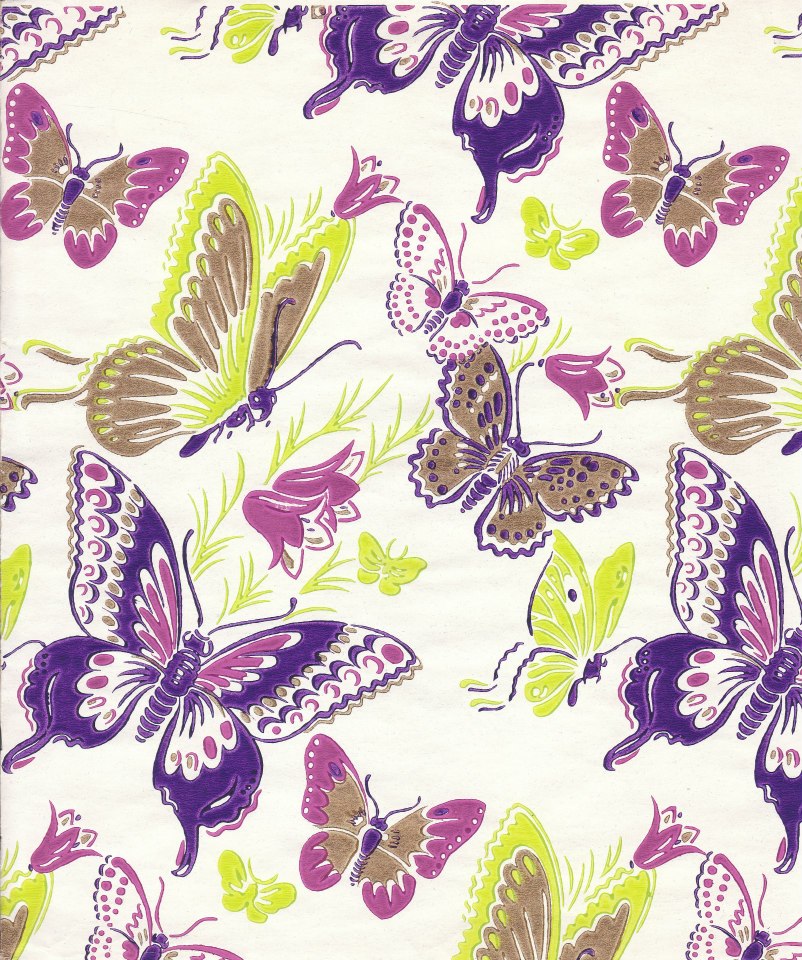
Among the items I found at this estate sale was a box of vintage gift wrapping paper with wonderful old designs.  I think most of them would be considered "Mid-Century" -- perhaps a bit earlier -- designs.  Here are some of them. 

Butterflies

Horses


Freesias

Pansies

Chrysanthemums

Lilies of the Valley (wedding)

This one had the name of the design on the border of the piece of wrapping paper. 
It says "Candlelight Wedding     Norcross * New York * USA."


Kittens

Tuesday, April 9, 2013

Dogs Don't Lie

In a St. Patrick's Day 2013 post, I described my experience having an Irish Setter as a Permanent House Guest, noting that many people upon seeing the Setter comment, "You don't see Irish Setters much any more!"  I said that I wasn't sure why.

I may be getting closer to the truth of the matter, thanks to two vintage magazines I found at a recent estate sale.  I'm beginning to think, having perused the ads in these two old magazines, that the Irish Setter retreated from popularity in the United States due to violations of Truth In Advertising laws.  Setter owners thought they were getting one kind of dog, but they got another instead.

Take this ad in the December 1957 issue of Good Housekeeping, for example.  It shows a loyal Irish Setter sitting with his handsome master on Christmas Eve, watching the man contemplate the wisdom of buying his wife more sterling silver flatware for Christmas.  All is calm, all is bright.


Don't kid yourself, Non-Setter Owner.  The dog in the picture is not admiring the silver spoon for its beauty.  Anyone who has ever owned a Setter -- or indeed almost any dog -- knows that the rapt facial expression clearly demonstrates that the dog thinks the red Christmas stocking holding the spoon is a Dog Toy.  Destruction of the stocking probably began minutes after the dog's owners turned the lights out.
 
The Setter, while fond of holidays, is more likely to be found on Christmas Eve curled up on the pillows in the master bedroom, catching 40 winks before he is kicked out to finish his nap on his dog bed in front of the tree.  Below is an actual, unretouched photograph of an Irish Setter on Christmas Eve.  So much for the Bambi-eyed adoration of his master's wisdom in choosing gifts; the advertisement clearly did not tell the whole story. 


Another advertisement from a July 1959 Los Angeles Times Home supplement (f0und at the same estate sale), shows other possible reasons for the Irish Setter's retreat from popularity.  The little girl in the ad is washing the dog while her parents laugh uproariously in the background. 


The child is using the same liquid to wash the dog, that her mother used to clean the inside of the stove and her father used to clean his golf bag.  Indeed, "Mr. Clean" was originally developed by a guy who had a marine ship cleaning business.  People actually used the same stuff to wash their dogs that they used to wash their cars and boats.  No wonder Setters didn't last long.

And this ad didn't tell the whole story of the Wet Setter. The illustration of the dog in the advertisement is smiling, happy, smooth-coated and holding still.  Note that it's an illustration, not a photograph.  Anyone who has ever washed a dog knows, that's not what they look like soaking wet.