Saturday, December 21, 2013

Vintage Christmas Gift Wrap

I enjoy finding vintage Christmas gift wrap at estate sales.  Here are some examples of my recent finds.


Thursday, December 19, 2013

Pyrography: Art by Fire

One of the most unique Christmas items in my collection came from my grandmother's estate.  It's a long, narrow wooden box with a hinged lid, almost three feet long, divided into three felt-lined sections inside.  It's decorated in a red and green poinsettia motif.


I had no idea who made the box until I looked on the underside:


By looking this name up online, I discovered that the Flemish Art Company of New York specialized in creating wooden boxes decorated with woodburned, or "pyrographic" designs.  

The term pyrographic comes from two Greek words meaning "fire" and "writing."  

The design was etched into the wood using a metal object heated in a fire, or, since the 20th century, by electricity.  The technique dates back to at least 700 BC.  The Victorians, I learned, were particularly fond of pyrography, but they called it "pokerwork."  A poker was a metal rod with a handle used to poke (rearrange or stir up) coal or wood in an open fire.  

As I read this information, a line from Louisa May Alcott's Little Women popped into my head: "...a bold attempt at poker sketching."


Chapter Twenty-six
Artistic Attempts

It takes people a long time to learn the difference between talent and genius, especially ambitious young men and women. Amy was learning this distinction through much tribulation, for mistaking enthusiasm for inspiration, she attempted every branch of art with youthful audacity...she devoted herself to the finest pen-and-ink drawing, in which she showed such taste and skill that her graceful handiwork proved both pleasant and profitable. But over-strained eyes caused pen and ink to be laid aside for a bold attempt at poker sketching.

While this attack lasted, the family lived in constant fear of a conflagration, for the odor of burning wood pervaded the house at all hours, smoke issued from attic and shed with alarming frequency, red-hot pokers lay about promiscuously, and Hannah never went to bed without a pail of water and the dinner bell at her door in case of fire. Raphael's face was found boldly executed on the underside of the moulding board, and Bacchus on the head of a beer barrel. A chanting cherub adorned the cover of the sugar bucket, and attempts to portray Romeo and Juliet supplied kindling for some time....

My grandmother's house in Alva, Oklahoma, was built in 1906, and this box dates to about that same era.  I like to think of it as being representative of Christmas in its day: a festive object in which treasures and memories may be stored.


________________________________________

Pictures and history of the Flemish Art Co. are at this website:

http://pyromuse.org/flemish_art_factory.html


There's a good article about pyrography on the CarversCompanion.com website:

Kitty Christmas, Part Two

Some Christmas images on old books, greeting cards and gift wrap are just too precious to consign to the shelf, a box or the recycling bin.  I like to at least make digital scans of them so I can share them, and save the actual items if they're particularly nice.

At a recent estate sale, I found a bunch of old children's books with Christmas themes, like Santa Claus and the Little Lost Kitten, from 1952.


I was particularly struck by one illustration by Louise W. Myers of the kitten, so I made a digital scan of it for you:


And someone, whose estate sale I attended, thought so highly of these Christmas images of tabby kittens that she put them in plastic frames and saved them.  I imagine she put them out at Christmas as part of her home decor.  


(They are pretty cute.  I wonder where I put the box of small picture-hanging supplies?)  

Wednesday, December 11, 2013

Kitty Christmas #1

I enjoy finding old Christmas items at estate sales.  A recurring theme in my finds, is the Christmas image of a cat or kitten.

Cats and Christmas are often linked -- in illustrations for magazine articles (like the kitten in Gyo Fujikawa's artwork for the Pearl S. Buck story in my previous post), in books (Cleveland Amory's The Cat Who Came for Christmas comes to mind), on countless home videos on YouTube, and especially on greeting cards.  

This vintage greeting card dates to the post-World War II era and is addressed on the back to Puddin', from Grandma and Grandpa.  


Monday, December 9, 2013

Another Ghost of Christmas Past

Based on what I see at estate sales, people tend to keep the Christmas issue of magazines more than any other.  Perhaps it's because of the recipes or craft ideas, or (in the case of very old magazines) because of stories by the featured authors.

Such may have been the case when I came across a copy of the December 1960 issue of Everywomans [no apostrophe!] Family Circle magazine.


I don't know why someone saved this particular copy of the magazine, but it may have been because of the featured story, The Christmas Ghost by Pearl S. Buck, illustrated for the magazine by Gyo Fujikawa.

Pearl Sydenstricker Buck (1892-1973) needs no introduction to readers of 20th century literature.  Born in West Virginia, raised in China by missionary parents, she won 1932 Pulitzer Prize for her novel The Good Earth, the 1938 Nobel Prize for Literature, and many other awards.  Buck's story The Christmas Ghost was published in book form in 1960, with illustrations by Anna Marie Magagna.  

I have great respect for authors who can successfully write for children as well as adults. Good juvenile literature has a clarity of expression, the read-aloud quality of "Once upon a time..." that can be difficult to write, and is lacking in so many so-called "grownup" books.

Even with great writing, the illustrations often "make" the story for the child, and the illustrations by Gyo Fujikawa may have been one of the reasons a family from 1960 saved this old magazine.  

Gyo Fujikawa (1908-1998) was not as well-known as Pearl S. Buck, but she made significant contributions to 20th century children's literature. Her obituary in The New York Times provides the highlights of her life:

Gyo Fujikawa, a prolific author and illustrator of children's books, including some of the first to feature children of many races, died on Nov. 26 at New York Hospital. She was 90 and lived in Manhattan.

The California-born daughter of a Japanese farmer and an aspiring Japanese social worker, Miss Fujikawa was among the first illustrators to command royalties rather than a flat fee.

Miss Fujikawa's father borrowed her first name from a Chinese emperor (the name rhymes with Leo).

She illustrated five books, including ''Mother Goose'' and ''The Night Before Christmas,'' and wrote and illustrated 45 others. She also designed six United States postage stamps, including the 32-cent yellow rose self-adhesive stamp issued last year and the United States-Japan Treaty centenary stamp of 1960.


Although she retired from writing and illustrating books in 1990, when her last two books were published, Barnes and Noble booksellers had recently approached her longtime literary agent about reprinting many of the ones that are out of print, said the agent, Bernard Kurman. The first two books she both wrote and illustrated, ''Babies'' and ''Baby Animals,'' have sold a combined 1.3 million copies and are still in print.


Fujikawa also created the design for the Eskimo Pie kid and for the baby on Beech-Nut Baby Food.  She is quoted as having said:


"In illustrating for children, what I relish most is trying to satisfy the constant question in the back of my mind--will this picture capture a child's imagination? What can I do to enhance it further? Does it help to tell a story? I am far from being successful (whatever that means), but I am ever so grateful to small readers who find 'something' in any book of mine."


Here's the story of The Christmas Ghost, with the artwork, scanned from the December 1960 issue of Everywoman's Family Circle.  Read it aloud to a child, or have the child read it to you.


Tuesday, December 3, 2013

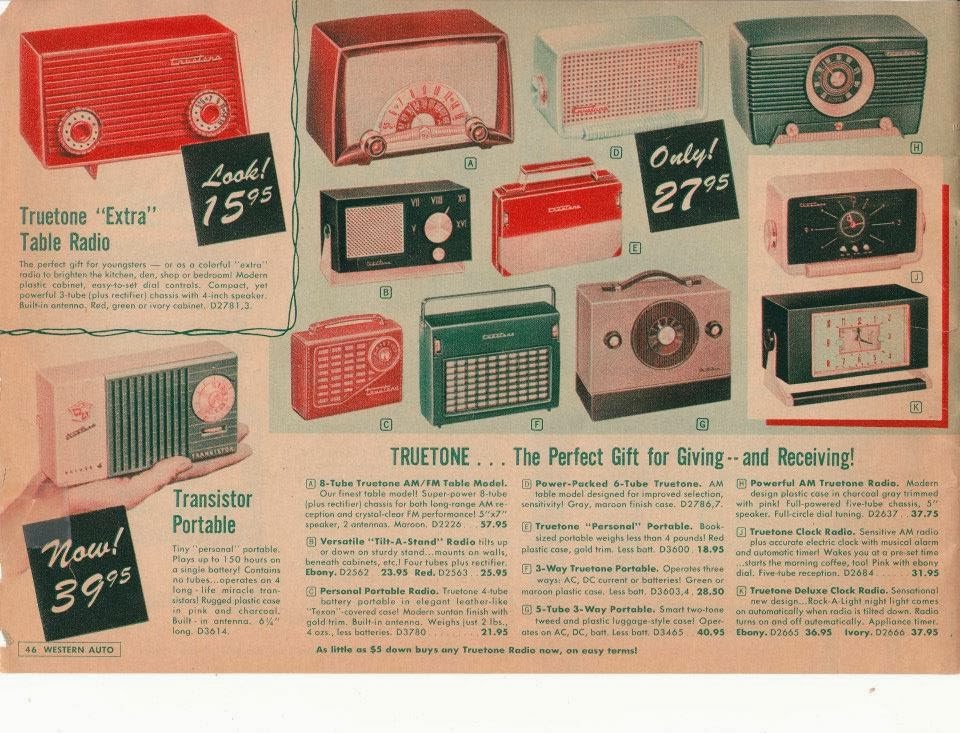
The 1956 Western Auto Christmas Catalog

In a previous post, I shared the cover of a 1956 Western Auto Christmas catalog that I found at an estate sale.  I thought it might be fun to share some of the pages inside the catalog as well. 


First, a little company history:

Western Auto Supply Company, Western Auto for short, was a chain of hundreds of retail stores founded in 1909 by George Pepperdine, who also founded Pepperdine University in Southern California.   

Throughout the year Western Auto offered automobile supplies and accessories.  At Christmastime, however, Western Auto's aisles were filled with everything from baby dolls to toy trains and so much more.

Let's check the mail from December 1956, and see what we might ask Santa to bring us for Christmas.  (Some of the pages are out of order, but we can still hopscotch down Memory Lane.)

First, a vinyl Bride Doll, Cindy Strutter Walking Doll, and Tiny Tears.


Betsy McCall cosmetics case, a child's tea set, a pink play stove and a jack-in-the-music box.


Boys' toys by Buddy-L, a Wyatt Earp double holster set, and a tiny piano.


 More dolls, and plush animals; doll carriages and more.


 More tea sets, and small appliances.


 Musical toys and furniture.


 Cootie, Sorry and other games.


Service station, toy phones, toy typewriters, and lots of sets for pretend jobs.


 Toys for little kids.


 Disney and other character toys.


The boys had been waiting to find their pages!  Metal farm sets, an Army Jeep, airplanes....


Outdoor toys.


Note the Dragnet police car.


Lots of TV cowboy toys.


 (The train under the tree was really for Dad, wasn't it?)


 "Robert" the Robot and other high-tech toys.


 Every kid should have his own radio station for Christmas.

More trains.


 Western Auto's house brand of bicycles.


Mickey Mouse and Roy and Dale watches.


More outdoor toys and accessories....


...including an air rifle for Ralphie.


And finally, we get to some gifts for older kids and for adults.


If you get Mom one of  these appliances, Dad, don't forget that she might like something else more romantic, too. 


 Gifts for the house.


Christmas decorations.


And, finally, the last page of the catalog, with hobby horses for the young equestrian in the family.

So what would you ask Santa to bring you, if you were enjoying Christmas in 1956?