Friday, April 11, 2014

War Letters: The Yankyettes

When I find letters at estate sales, they are almost always personal letters, to and from friends or family members.   Yesterday, however, I found a letter that Loretta had saved from the head of the Local Services Committee of the USO.  

It's dated August 1, 1942:


If you're not familiar with the United Service Organizations, you're probably not old enough to be reading this blog.  :)  Here's a little history for you youngsters, from the USO website:

Supporting America’s troops was the first mission of the USO. In 1941, as it became clear that the nation was heading into World War II, several organizations mobilized to support the growing U.S. military: the Salvation Army, Young Men’s Christian Association, Young Women’s Christian Association, National Catholic Community Services, National Travelers Aid Association and the National Jewish Welfare Board.
President Franklin D. Roosevelt created synergy among these agencies by forming the United Service Organizations, with the objective of providing the emotional support the troops needed.

The letterhead is interesting because Dr. A.H. Giannini was the Chairman of the LA Area USO Board.  Giannini was one of the founders of Bank of America, known as the "angel" of the early Hollywood film industry, approving millions of dollars in loans to producers when other banks refused to.   He died less than a year after this letter was written by the Chair of the Local Service Committee, the Rev. James E. Dolan.

The address, 941 South Figueroa Street, Los Angeles, was built as a YWCA in the 1920s.  It was the location of one of several USOs in Southern California.  

Norman Rockwell illustrated the importance of the USO to the stateside soldier
in this Saturday Evening Post cover

Before you get your reading glasses out, I'll enlarge the paragraphs one by one.  Loretta Golino and the Yankyettes had been singled out for "special acknowledgement" by the U.S.O.:


"Dances at the Y.W.C.A. always afford a real treat to the men who are fortunately enough to be invited..."


Loretta and  the other Yankyettes gave "splendid assistance" to the "all-important morale-building effort" of the USO in 1942.

I wasn't able to find anything about the Yankeyettes on the Internet.   And -- for good reason -- the downtown LA USO was overshadowed by the USO branch in nearby Hollywood.  It seems the Yankyettes were just a small part of the stateside war effort.  But an important part.

A veteran named Chuck Hinman did write his memories of the USO in Southern California, for Columbia Magazine:

http://www.columbiamagazine.com/index.php?sid=61075

USO canteens quickly found

'Soldier boys' in large cities such as Los Angeles quickly found the very popular USO canteens. I was no different. I 'lived' at the canteen in my free time and developed many heart-throbs! And of course, I became a noted (not) pool shark and skilled ping-pong player! I cut my teeth, so to speak, on the dance floor at the canteen but no one mistook me for Gene Kelly or Fred Astaire. There was little resemblance!

The canteens were ALWAYS staffed with pretty, nice girls to the delight of us service-men. A very popular song of the day made popular by Sammy Kaye was" I Left My Heart at the Stage Door Canteen" by Irving Berlin: This Stage Door Canteen was the subject of the very popular Broadway play of the same name.

Marlene Dietrich at the Hollywood Canteen

During my short two-months stay in Southern California, I discovered the Hollywood Canteen. On a visit there one Sunday afternoon, I had the pleasure of being served refreshments by the glamorous Marlene Dietrich! Of course, everyone crowded to have their picture taken with the famous German movie star! I also heard the famous singer Peggy Lee do her rendition of the song "Fever" for which she became noted. Movie stars and starlets were a dime a dozen on this Sunday afternoon! After all, I was treated to being a guest in their backyard, so to speak.

As you can understand, I am rapidly beginning to be spoiled by this 'new life'!

Overwhelmed by outings

And that's not to mention being invited to a super-glamorous home in Hollywood on Thanksgiving Day along with my roommate and a couple of buddies who had signed up at the Los Angeles USO canteen for such an outing. What opulence and down right genuine hospitality! Our country has a wonderful history of its citizens pouring it on for its soldier boys!


(I wonder if he ever met the Yankyettes?)  

_______

Resources

I'm going to donate this to the Center for American War Letters at Chapman University.  

http://www.chapman.edu/research-and-institutions/cawl/index.aspx

Here's an ABC News documentary on the "home front" during World War II.  About 21:30 in, is some footage of USO dances:

https://www.youtube.com/watch?v=ZPP0ae2zrXY

Here's an article on the building which housed the YWCA at 941 South Figueroa:

http://www.kcet.org/socal/departures/columns/lost-landmarks/the-figueroa-hotel-the-surprising-feminist-origins-of-a-sexy-downtown-staple.html

A short history of the USO during World War II, with lots of pictures, is available online:

https://archive.org/stream/USOFiveYearsOfService/FiveYearsOfService#page/n0/mode/2up

You can do a search for photos (there are about half a dozen) relating to the USO in Los Angeles, at the Los Angeles Public Library website:

http://photos.lapl.org/carlweb/jsp/photosearch_pageADV.jsp

And here's a link to the history of the USO:

http://www.uso.org/history.aspx

Vintage Easter Card Images, Part Four


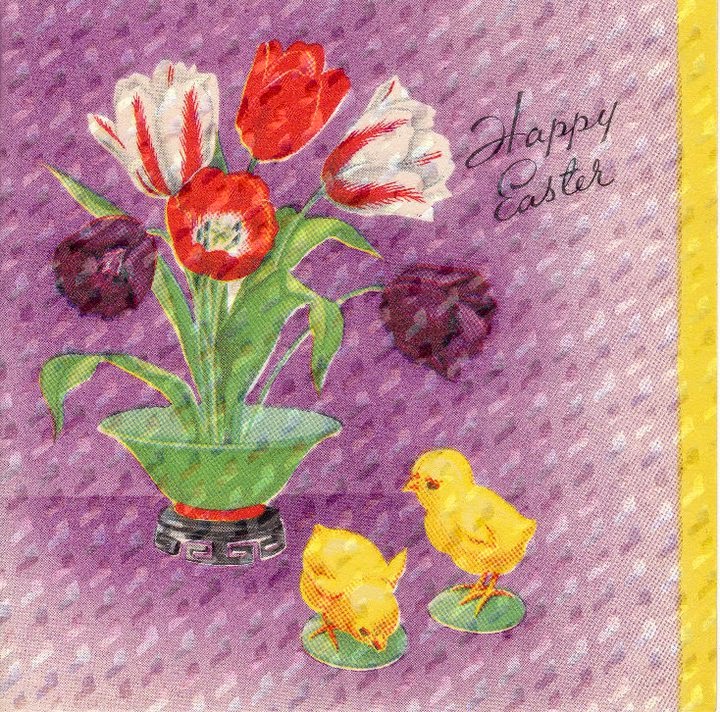
Here's volume four of our vintage Easter cards.  The last one in this set is an postcard, somewhat older than the other images.


Thursday, April 10, 2014

Vintage Easter Cards, Part Three

I've been posting digital scans of lovely, mostly mid-century, Easter cards on this blog this week.  

Here are some more images.  Enjoy!


Wednesday, April 9, 2014

Vintage Easter Cards, Part Two

Here are more lovely old Easter card images, from cards I've found at estate sales.  


If you missed my previous post of Easter card images, it's here: 

 http://estatesalechronicles.blogspot.com/2014/04/vintage-easter-cards-part-one.html

Tuesday, April 8, 2014

Vintage Easter Cards, Part One

Easter is April 20 this year.  I want to share some of the lovely Easter greeting card images that I've found at estate sales.

Online sources say the first examples of people sending Easter greetings through the mail  was in the late 19th century.   Most of the pieces in my collection of Easter cards date to the mid-20th century.

Here is the first installment of the Easter card images!  Check this blog again soon, for more.


The Right Somebody to Love

Not long ago, we lost a great actor. Philip Seymour Hoffman's career was tragically cut short by his death at age 46.  In reading about his career, I was struck by a quote Hoffman once gave a reporter.  NPR put it on their Facebook page:


...Just to be loved, I think, is, like, the thing that gets you up in the morning.

Is that true? Does being loved give you the strength to face the day?  Perhaps it can.  But perhaps there's also a form of love that's more important.  When I read the quote from Philip Seymour Hoffman, I immediately thought of Shirley Temple.

(That's not a non sequitur.  Stay with me.)


A few weeks after Hoffman's death, we also learned that Shirley Temple Black died, at the age of 85.  If you're old enough to be interested in this blog, I probably don't have to tell you who Shirley Temple was.  


People saved their Shirley Temple dolls, paper dolls, sheet music, books, photographs and other memorabilia.  I've often seen other Shirley Temple memorabilia at estate sales.

Sheet music from a Shirley Temple film
A couple of years ago, I found a bunch of original vintage Shirley Temple paper dolls.  I took them with me the next time I visited by mother, and asked her to tell me again about her experiences watching Shirley Temple movies as a child.


Shirley Temple paper doll


One of paper Shirley's paper dresses.  Note the wide collar.

My mother remembered seeing Shirley Temple's films in the theater with her mother and her older sister in the 1930s.  Mom also (ruefully) remembered my grandmother's attempts to dress her daughters in matching outfits "like Shirley Temple would wear."


Dresses worn by my mom and her older sister.  Note the wide collars.

Even if Mom didn't appreciate having to dress like Shirley Temple, the songs and dances from the films stuck with her, to the point that Mom was able to teach her own kids the lyrics to "Animal Crackers in My Soup" and "Be Optimistic" all those years later.

There had to be more to the classic Shirley Temple films -- Little Miss Marker, Bright Eyes, Baby Take a Bow, The Little Colonel, Curly Top, Little Miss Broadway (and I'm just scratching the surface) -- than a cheerful message that helped people muddle through the Great Depression. There must have been underlying messages in Shirley Temple films that people identified as Truth, and took them to heart (or at least tried to).  

So when I heard that she had passed away, I remembered again this song from another Shirley Temple film, Captain January, and I wondered -- is this just an old-fashioned, out-of-date sentiment?

What makes life the sweetest,
Bestest and completest?
Not a big doll house,
Or a Mickey Mouse,
But the right somebody to love.

Ice cream, cake and candy
May be fine and dandy,
But if you ask me they're not one two three
With the right somebody to love.

One you really care for,
And is yours to have and keep;
One you say a pray'r for
In your "Now I lay me down to sleep".

Tho' you're not quite seven,
What is most like heaven?
It's the joy that's found
With your arms around
Just the right somebody to love.

-- Music and lyrics by J. Yellen / L. Pollack, from the film Captain January (1936) 

It's interesting that in this song, love is active, not passive; it's not just a feeling*.  Love is giving, not receiving. Love is doing what's best for the other person.   

* Obi-Wan was wrong, Luke:  Don't entirely trust your feelings.  They change too often.

There are other lyrics to the song that didn't make it into the film:


You may have a bankful,
For which to be thankful,
Nothing you possess,
Brings you happiness,
Like the right somebody to love.

(Try singing that to a 21st century professional athlete or corporate CEO, whose income is higher than the GDP of a small nation.....)  

So is the idea that not just receiving, but giving love important, an old-fashioned thought that has gone away?  I'm pleased to report that apparently it has not.  Alexander McCall Smith expressed a similar thought at the end of one of his books in the No. 1 Ladies' Detective Agency series, called In the Company of Cheerful Ladies:

...She had so much love to give -- she had always felt that -- and now there was somebody good to whom she could give this love, and that, she knew was good; for that is what redeems us, that is what makes our pain and sorrow bearable -- this giving of love to others, this sharing of the heart.


And so, it seems, we have our marching orders. Do what's best for them.

____

Here's a short video clip of Shirley singing the song to her doll in Captain January.  Little Shirley's character, Star, is an orphan, and the doll is named "Mother."


Here's a longer version of the song, with Shirley singing to "Cap" (Guy Kibbee), who took her in when she was orphaned.  Poor Guy Kibbee, to have to appear in a dream sequence dressed like this....  But it underscores the idea that real love is giving, not just receiving.

https://www.youtube.com/watch?v=DgfUqVLjKOc

(My apologies to those of you who can't get the tune out of your head now.)


Friday, March 14, 2014

The Sharing of the Green

In honor of St. Patrick's Day, here are a couple of vintage St. Patrick's Day cards I found at an estate sale.

The estate was that of Edward, who had served in World War II and later lived with his mother Elizabeth, taking care of her till she passed away.  

This card was sent by Elizabeth to her sister:


Notice the old microphone on a stand, with the call letters "SP" on top, and the Mary Jane shoes on the Irish lassie.  

Inside, the humor is true to the period, probably sometime in the 1930s or 1940s:

It's a "Pat and Mike" joke, of sorts.


The inside of the card is addressed "To my little sissie Mad"  (Madeleine was the sister's name).  "XXX" is Elizabeth, and "Ed." was her son.

In the same stack of cards at the estate sale was one sent by a friend to Elizabeth.  It probably dates to the late 1960s-1970s.


Here's hoping you are thinking of your friends and loved ones on St. Patrick's Day, too.