Sunday, July 6, 2014

The Quilter's House

It's very common, around here, to see online listings for estate sales that feature "sewing and crafting supplies."  


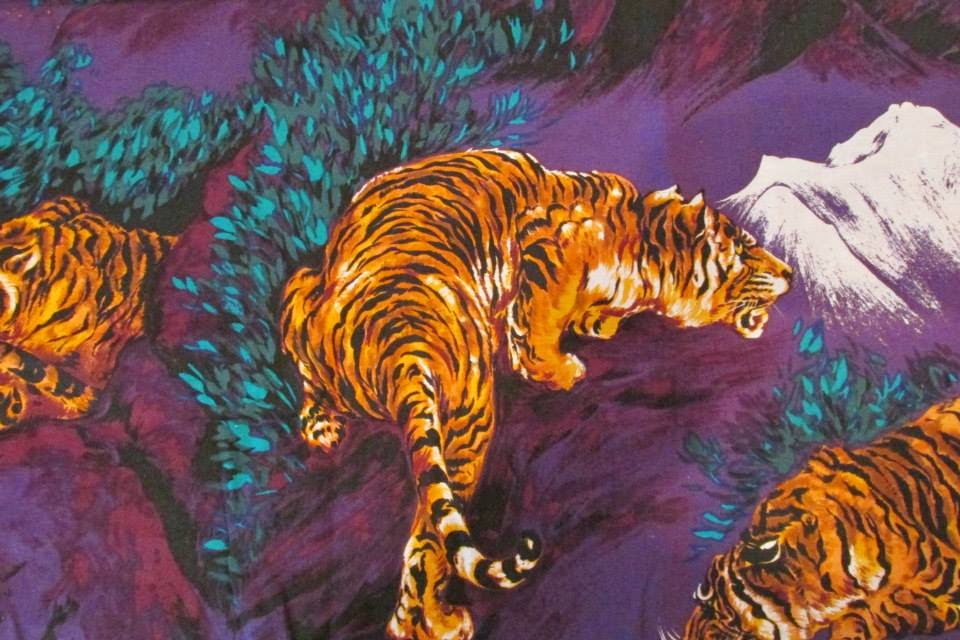
But I don't think I've ever seen as large a collection of fabric as the one I saw at an estate sale a few weeks ago.  The woman who owned the old house in the historic neighborhood had taught quilting for many years.


The first floor of the house contained furniture, books and pictures.  The entire second story of the house, including a sleeping porch, was filled with quilting fabric and books, mostly books about quilting.  I don't think I've seen a fabric store recently, with that much cloth.

With the owner of the home's permission, I took two pictures of a portion of the fabric they had for sale, with my cell phone camera.  I could have taken 20 more pictures like this, and I wouldn't have photographed it all.


The people holding the sale, including the young man who's inherited the estate, told me they'd already sold a great deal of the fabric to people who'd known the quilting instructor.  This was what was left over.  (Whatever didn't sell, they said they would donate to charity.)


Because they had so much (understatement of the year), they were selling the remaining fabric by the bag -- small, medium and large.  I thought, What a great deal!  I could probably use some fabric, or find it another home.  So I got a small bag and started sorting through the piles of cloth.


Hm.  Maybe I should get a medium-sized bag.


Okay then, I'll get a large bag to hold the fabric I want.


And I don't even quilt.

I also found a couple of quilted cats, presumably made by the quilting teacher.  One of them didn't have a ribbon, so I was persuaded to give it away to what I was assured was a good home.


The other quilted cat, I think I'll keep away from other, jealous, felines.  It will remind me of the unknown woman who was so passionate about her craft and shared her love of quilting with others.


Saturday, July 5, 2014

Harry Doehla Company Greeting Cards

Occasionally I find something at one estate sale that is related to something I find at another sale.

Such was the case with the Cute Kitten get-well card.


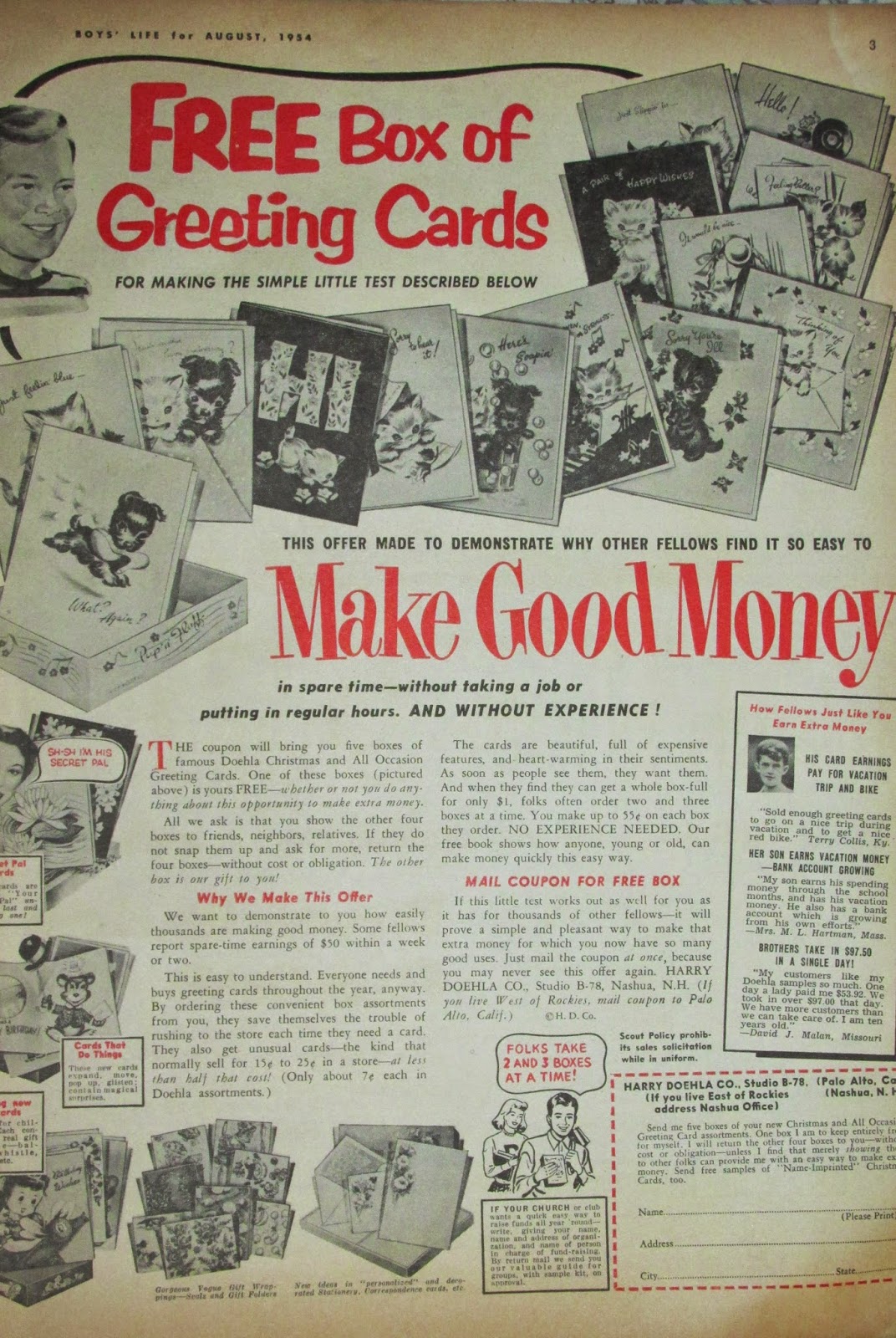
I bought it, along with several dozen other used 1950s greeting cards, at one estate sale.  When I got it home and looked at the image, I thought, "Where have I seen that design before?"  After a moment's reflection, I got out the small stack of 1954 copy of Boys' Life magazines I'd picked up at another and flipped through them.

Bingo.


The kitten card was in an ad exhorting the young readers to sell greeting cards for fun and profit.


The ad was for the Harry Doehla Company of Nashua, New Hampshire.  I'd heard of that somewhere before.... I then retrieved a "salesman's sample" book of old greeting cards that I'd found at another estate sale and, bingo again, the book held cards by the same company, Harry Doehla.


This collection of Christmas cards was even endorsed by Art Linkletter.


Inside the album were samples of Christmas card designs that the buyer could have pre-printed with their name, saving time and adding a certain style to the greeting.


Harry Doehla's business was one of several greeting card companies operating during the 1930s through 1960s that had teenagers and adults sell their wares to family, friends, club members, congregation members and anyone else who might need to send a greeting to another person.  

Doehla was an unexpected American entrepreneur.  An illness left him in a wheelchair at age 18.  With his parents' help, Doehla invested in greeting cards that other people would sell, and he was a millionaire by age 32.  His company operated nationwide.


Another blogger has chronicled the history of the Harry Doehla Company:

http://vintagerecycling.blogspot.com/2013/08/doehla-greeting-cards-inc.html

And here's a 1962 newspaper article on the company:  http://news.google.com/newspapers?nid=2209&dat=19620630&id=xrUrAAAAIBAJ&sjid=1v4FAAAAIBAJ&pg=5126,5946058


Friday, July 4, 2014

War Letters: Your Unknown Admirer

Since it's the Fourth of July, I thought another War Letters story might be appropriate.  


A few months ago I found a box of old letters at an estate sale.  A lady had passed away, and no one else seemed interested in them.

I opened the box and saw what was inside.

V-Mail.  War letters.  Yes. 


So often at estate sales, I see people who collect stamps buy old letters just for the stamps on the envelopes.  I'm afraid a lot of the correspondence inside just gets tossed in the trash or in a recycling bin, and the stories of our men and women in uniform are irretrievably lost.  

I read some of the letters, which told snippets of the stories of several members of the Greatest Generation.

Like many young women during World War II , Yvet in New York City corresponded with several young men who were off serving their country.

One was Jesse, protecting the coast of Mexico from attack :


"...Our job was to survey and lay out balloon sites along the Mexican coastline.  It was a tough, God-awful job -- the Pacific coast of Mexico is just about the most deserted place in the entire world -- and I'm a person who likes to see lots of people, big cities, etc., and stare a Scotch and soda straight in the eye.  It was all work, and absolutely no play. (As a matter of fact, the first thing I did when I got back to California, was to go on the world's hitherto greatest known bender)...."

One was John, at the Naval Mine Warfare School in Virginia:


"I'll be you think I'm getting very lazy, not answering your letter sooner, but I just got it today...."

One was Morrie, recently promoted to Captain, who sent her V-Mail from Somewhere in England:


"...The Group officers including myself are set up in an English Manor House which has all modern conveniences.  In fact it is a modern house -- only three hundred years old.  We have an inside toilet and bath.... The house is surrounded by a tremendous lawn with some beautiful gardens that are maintained by a gardener employed by the Air Ministry from whom the good old US rents it on a reverse Lend Lease proposition.  The food is excellent....  Of course my pilots have a slightly rougher time of it but so far they are doing an excellent job and managing quite well...."

And one was Abe, in basic training in Texas:


"Yours received and am always so happy to hear from you.  Snow has just melted and am enjoying Indian Summer in the great Southwest...."

And Yvet wrote to them all.

Somewhere along the line in 1943, one of Yvet's letters to Abe was accidentally delivered to another soldier with the same first and last name, stationed not in Texas but in England:


"Am writing to you this short note to inform you of my mistake in opening your letter.  As you can see by my name that I was really justified in doing so.  I am enclosing your letter so that you will not be too hard on my namesake for not answering.  I would love to heave from you when & if you receive this note..."

Abe #2 explained that he didn't get much mail, and he felt some sort of connection to the young woman whose letter he'd received by accident:


"...I also come from New York which makes you & I a little closer.  Hoping you receive this in good health I remain, your unknown admirer, Abe."

And she wrote back to him as well.

The letters Yvet saved from the Second Abe cover a period between 1943 and 1945.  He wrote to her from Somewhere In France (according to the heading of the letter) of his experiences with a French family:


"It has been my pleasure to be introduced to some very nice French people, with whom I have become real friendly.  A mother, whose husband has been a prisoner of the Germans for the past two years.  Her daughter, a young girl of 14, who is studying to be a stenographer and typist.  Whenever I get the opportunity I am always [visiting? writing?] at their house.  There is..." [next page]


"...nothing they wouldn't do for me.  This Christmas, I have been invited to a supper, which I hope I can be able to make.  There are so many things that these French people have gone through that it would take quite a time to relate...."


Yvet saved all these war letters from servicemen.  Did she marry one of them after the war? Apparently not.  The box also contained the draft card of a fellow named Moe, who didn't join the military until a few months before the end of World War II -- and a copy of a wedding invitation for Yvet and Moe dated May 1946.  There were also telegrams congratulating them on their marriage, and letters from friends and relatives dated after the wedding.

Still, she saved all these letters from her friends.

They'll be going to the Center for American War Letters at Chapman University, to join the other war letters I've found at estate sales.  Scholars and researchers will be able to use them, along with the 90,000+ other letters in the collection, to piece together more information about what went on, at home and abroad, during World War II.

Here's their website:  http://www.chapman.edu/research-and-institutions/cawl/index.aspx


Thursday, July 3, 2014

Rudyard Kipling and The Janeites


Jane lies in Winchester—blessed be her shade!
Praise the Lord for making her, and her for all she made!
And while the stones of Winchester,
      or Milsom Street, remain,
Glory, love, and honour unto England’s Jane!
-- Rudyard Kipling

It's always interesting to find old books by British authors at estate sales.  A couple of weeks ago, I came across a paperback anthology of short stories by Rudyard Kipling that I wasn't familiar with. I opened the book to a story called The Janeites.

The title stopped me for a moment.  I knew that a "Janeite" is someone who really likes Jane Austen's novels -- it's either a compliment or an eye-rolling insult, depending on whether the speaker also enjoys Miss Austen's works.

Rudyard Kipling (1865-1936)

Jane Austen (1775-1817)

I don't usually associate Rudyard Kipling -- he of the classic children's stories, poetry and tales of the British military in the 19th and early 20th century -- with gentle Jane Austen.  

The Janeites is about a group of World War I veterans recounting how they came to know and appreciate -- even love -- Miss Austen's novels.  

Jane Austen's writing table

A short scholarly analysis of The Janeites is on the website of the Rudyard Kipling Society (UK): 

http://www.kiplingsociety.co.uk/rg_janeites1.htm


This article breaks the story down for us:


The story has three main themes. First in literary importance, it contains a deep appreciation of Jane Austen [1775-1817] which is made all the more pointed and piquant by being put into the mouth of a very simple-minded and uneducated man in the ranks who has been induced to study her works under the impression that her admirers form a kind of secret society which it pays to join. Secondly, the story gives a good account of the working of heavy artillery in France in 1918 and pays a great tribute to the men who manned the guns.... Thirdly, there is the Masonic background against which the story is told.

Kipling wrote the soldiers' conversations in dialect.  The veterans of the Great War take the long way 'round to explain why they like Jane Austen's novels: it's because the characters are so realistic.


'They was only just like people you run across any day. One of ’em was a curate—the Reverend Collins—always on the make an’ lookin’ to marry money. Well, when I was a Boy Scout, ’im or ’is twin brother was our troop-leader. 

'An’ there was an upstandin’ ’ard-mouthed Duchess or a Baronet’s wife that didn’t give a curse for any one ’oo wouldn’t do what she told ’em to; the Lady—Lady Catherine (I’ll get it in a minute) De Bugg. Before Ma bought the ’airdressin’ business in London I used to know of an ’olesale grocer’s wife near Leicester (I’m Leicestershire myself) that might ’ave been ’er duplicate. 

'And—oh yes—there was a Miss Bates; just an old maid runnin’ about like a hen with ’er ’ead cut off, an’ her tongue loose at both ends. I’ve got an aunt like ’er. Good as gold—but, you know.'

More subtle, but important to an understanding of the story, is that reading Jane Austen and other classic works of English literature provided soldiers with a much-needed escape from the horrors of trench warfare.  Collections of pocket-sized books, the most famous being the Nelson's Continental Library series, were printed for British soldiers in World War I.   

Jane Austen's House, Chawton, UK


You can read Kipling's story The Janeites here, on the website of the Jane Austen Society of North America: 


And if you want to read a short scholarly article on the story, here's the website of the Rudyard Kipling Society (UK): 


The authors of the scholarly article tell us of critics who liked The Janeites, and others (including C.S. Lewis) who found the "insider," secret society angle in Kipling's work to be insufferable.  

This article also notes that Kipling and his wife found solace in reading Jane Austen's novels after their oldest son, John, was killed in World War I.  

Winchester Cathedral, where Jane Austen is buried


Wednesday, July 2, 2014

A Prayer for My Little Sister, 1898

If you have a sister, or someone you love like a sister, this post might be of interest to you.

Often at estate sales, I find an old letter that someone has saved.  Too often, I have no idea who the sender or the recipient of the letter were -- sometimes there are only first names to provide a clue.

Such was the case with the single, small sheet of paper I found mixed in with some old Christmas cards at a recent estate sale.  There was no envelope, no address, not even a signature.

But I thought it would be worth it to share the writer's thoughts, more than a century after she wrote them down.


Shandon, Cal.
March 12, 1898

My own dear sister Fannie;
Today
you enter upon another
year of your pure, young
life.  You cannot imagine
how nearly impossible it
is for me to realize that
my baby sister is now
sixteen.  From the depths
of my heart, dear sister
I wish you many, many
happy returns of your
birthday, and hope that 
the future years hold


a goodly share of joy 
and comfort for you
-- also patience -- and
longsuffering to endure
all the trials placed
in your pathway.

I am sure you will
strive to make each year
one of usefullness and
an improvement on 
the one gone before.

Continue to be pure
in thought, word and 
deed and always, under
all circumstances take
everything to God in prayer.

May His mighty protection 
and tender mercies be
with you always.

Tuesday, July 1, 2014

The Almost-Forgotten Man: 1880s Memories from Yolo County, California

Most of the items I find at estate sales are pretty "pedestrian" -- things that almost anyone who lived during the middle of the 20th century would have saved and left behind.

But sometimes I come across unique items from an earlier time.  Such was the case at a recent estate sale, where someone had saved some family papers that show us little snapshots of life in rural and urban Northern California in the late 19th century.


The first item was a ledger, or "cash book" as it was labeled by the previous owner.  The book is a journal -- leather-bound, with gilt decorations.  


The owner, a Mr. E.L. Booth of Dunnigan, California, covered the book with a piece of heavy paper and wrote on the front:


Front of Cash Book
1878 to 18__
Dunnigan
E.L. Booth

A quick perusal of Ancestry.com told me that this was Edward L. Booth, born in Illinois in 1861.  At first I thought it was odd that he never filled in the end date for this record of his expenses.  Later I learned there was a reason why.


Inside the Cash Book were two hand-written copies of an "indenture" document dated September 1, 1880.  They are written on large, lined pieces of paper and show that Charles and Edward Booth had a farming arrangement with a local land owner.  They worked the land and, in return, the land owner would receive a percentage of the crops.


Two pages later, the document concluded:


So Edward and Charles were farmers.  Edward used the leather-bound book with the handmade dust jacket to detail his business and personal transactions -- money spent and received.

The Cash Book shows activity from 1878 to 1887, in rural northern California -- mostly the area around Sacramento.  The notations provide an interesting snapshot of life more than 100 years ago.

Edward Booth also recorded his expenditures when he traveled outside of the small town of Dunnigan, about 40 miles from Sacramento:

1878
Sacramento Sept. 3-5
Coat (7.00), Bible (1.50), Box collars (.65)  $8.65
China boxes (1.35), Book for Ross (.60)         1.95

Edward had an older sister named Phebe and brothers named Charles and Rossiter (Ross).  The book shows that he often bought them gifts.
Later in 1882, Edward spent the week of October 19-26 in the city of San Francisco.  It must have been quite an adventure for a 21-year-old farmer.  He noted that his railroad fare was $8.20.   While he was in The City, he saw the sights and bought a lot of presents:
Bracelets, Breast pin  $13.75
Writing desk for Ross  3.00
Scrap book for Chas.  1.50
Harmonica, Ross  1.50
Theatrical  1.90
Author's Carnival  .70
Golden Gate Park & Cliff House  .40
Woodward's Garden  .30
Museum  .50
Sea Shells for Ma & Phebe  1.50
Basket  .75
Maple Sugar, Candy and C. Nut (coconut?)  1.45
Street Car fare  .10
Collars & socks  .45
Salmon  .25

I looked at several websites, to see if I could find out what was going on in San Francisco while young Mr. Booth was there.  The San Francisco Museum website notes:  October 20, 1882: There was a very sharp earthquake shock that woke people up this morning.  (Edward didn't mention it in his ledger.)

The website SanFrancisco.com tells us that Golden Gate Park was almost new when Edward visited:

In the decade after the Gold Rush, the people of San Francisco began to wonder about the possibility of a grand public park in their West Coast city. In a matter of six months, engineer William Hammond Hall developed a design for Golden Gate Park and with the crucial help of his assistant, John McLaren (later world-class park's dedicated superintendent for almost 70 years), started the process of leveling the wind-swept, ocean-sprayed sand dunes that covered the current area of Golden Gate Park.
By 1879, only nine years after the initial plan and design, Golden Gate Park had already transformed from barren beach to abundant forest with more than 155,000 trees on 1,000 acres of land....

The Cliff House Edward mentioned was the original building, according to the National Park Service website:

After the Gold Rush, San Francisco's population exploded and the city's downtown area got very crowded with new buildings and neighborhoods. Real estate developers, eager to make more money, saw Lands End and its unparalleled beauty as a new place to develop. They constructed the Cliff House in 1863 as a fashionable resort for the wealthy. The modest one-story wood-frame structure was skillfully situated on top of the cliff overlooking Seal Rocks, providing breathtaking panoramic views of the Pacific Coast line.

During the mid-19th century, trekking out to Lands End was expensive and took several hours by horseback. To help people travel to this faraway place, a private company constructed a brand new road called Point Lobos Avenue. Eventually, a horse-drawn stagecoach made the trip every Sunday from downtown San Francisco out to Lands End. Because only wealthy citizens could afford to travel all the way out to the remote resort, the Cliff House was considered a very exclusive place. For many years, the guest register bore the names of three U.S. presidents as well as prominent San Fran¬cisco families such as the Hearsts, the Stanfords and the Crockers. However, by the late1870s the Cliff House had declined in popularity. In an effort to attract new customers, the managers offered gambling and alcohol and as a result, the resort became shabby and unrespectable.

In 1881, Adolph Sutro, the self-made millionaire, philanthropist, and later mayor of San Francisco, bought the Cliff House from the original owners. He had plans to re-establish the restaurant as a wholesome, family-friendly venue and for next few years, he remodeled rooms, hired new management and lured families back to the restaurant. Sutro also began construction on a railroad that would transport more people to this seaside attraction. Unfortunately, a very tragic event happened on Christmas Day, 1894 when fire destroyed the original wood-frame Cliff House.


Woodward's Gardens are not there anymore, according to SanFranciscoMemories.com:

Woodward’s Gardens was an attraction from San Francisco’s past that has been mostly forgotten. It was a combination of zoo, museum and amusement park in a beautiful garden setting. During its years of operation (1866-1891), thousands of people came to the gardens to enjoy the surroundings and learn more about their world.

In 1885, Edward took his mother to see the State Fair in Sacramento:


It appears that Edward Booth was a generous and honest young man.  He bought gifts for his family members; he gave money to his church.  In December 1885, he noted, he bought a Christmas card for a Miss "Abbie R."  The ledger also shows that Edward and his family members -- including his sister Phebe -- often loaned one another money over the years, and it appears that Edward paid it back.

Towards the end of his ledger entries, though, Edward was not doing well financially.  The inscription under "Debits" in January 1887 reads, "Well, I am Broke."  


In February 1887, under "Credits," he noted that he sold some feed sacks and had cash on hand again.


Then in March 1887, the journal entries stop abruptly.  


The rest of the ledger is empty.  I wondered why, so I went back online and did some additional research on Edward L. Booth of Dunnigan, California.


Edward died March 17, 1887, at age 25.  He's buried in the cemetery in the tiny town of College City, California, along with his father, who passed away in 1881, and his mother, who died in 1898.

I looked through the other items I found at the estate sale, to see if I could piece together any other information about Edward Booth.  I was able to deduce from the names and addresses on some old letters and envelopes that the estate contained items from Edward's little brother Rossiter Booth's family. 

But since there were several hundred other buyers at the estate sale, I thought the chances of my having unknowingly purchased anything else of Edward's were pretty small.

Late this afternoon, however, I looked in the bottom of a small cardboard box I'd brought home from the estate sale. Someone had used it to store a few post-World War II Christmas cards and assorted scraps of paper.  

At the bottom of the box was a plain white envelope, unsealed, with one word written faintly in pencil on the front:

Edward

Inside, was one of Edward L. Booth's calling cards.


Someone in his family saved this small reminder of their brother, who "went home" so early in his life.  But their gesture was not in vain; this token of their love is now on the Internet.  And now we can all remember him.
_____________________________________

There's only one thing to do with old documents that show small slices of life, more than 125 years ago.  I'm sending them to the Yolo County Historical Museum in Woodland, California, for their collection.  

http://www.gibsonhouse.org/