Saturday, November 19, 2016

The All-American Girl and the Letter from Santa


The other day I came across a plastic bag with some items I had found at a “living” estate sale a couple of years ago.  The elderly woman whose things were being sold didn’t need them anymore, we were told, because she was moving to a smaller place. Her name is Mary.  (Since I believe she and some of her family members are still alive, I’m not going to share her last name here.)

Mary saved a lot of what’s called “paper ephemera.” Among the cards and envelopes in her collection was a Letter from Santa that her daughter received just before Christmas in 1961.


The front of the envelope was hand addressed to the child, postmarked Santa Claus, Indiana – rather a long way from the North Pole, but perhaps when you're little that doesn't matter.  The back of the envelope shows us that her mom had worked with the folks at the local Montgomery Ward store to get Santa to write.


This letter from Santa is evidence that someone led a rather typical mid-20th century American family life. But the other pieces of paper ephemera I brought home from the estate sale tell, as media commentator Paul Harvey used to say, “the rest of the story.” 

Mary had also saved memorabilia from her high school years. In 1947, she graduated from Excelsior Union High School in Norwalk, California. Cross-checking her on Ancestry.com, I can see that in her senior year, Mary was the secretary of Excelsior’s chapter of the National Forensics League, the forerunner of the National Speech and Debate Association.


Several of Mary’s classmates and teachers signed the back pages of her small “Memories” book. Her senior year school yearbook photo, also accessed on Ancestry.com, shows the young woman that her classmates described as “brainy,” “peppy” and “wonderful," and alluding to her skill as a debater. 


The last person to sign Mary's Memories Book was her Forensics League sponsor, Mr. Hanks:


Dear Mary:
‘Tis always a sad time to say “Good bye.” In this case, it will not be for I have only memories of a most efficient secretary, a most pleasant person, a young lady of the most courteous type, an American who really knew what the ideals of our country meant to people. We’ll miss you – but we’ll feel better for our memories.   
Day Hanks

The most significant item I found among Mary's graduation papers was the special Certificate of Merit in Citizenship she received from her school.


In 1946, Mary’s junior year, she doesn’t seem to have participated in any extracurricular activities.  She looks thoughtful, perhaps a little sad, on the far right of a row of students in her junior class group picture.


The 1945 Excelsior Union High yearbook doesn’t show a photo of Mary. That’s probably because of what the official records from the time reveal: Mary and her family lived in Arkansas from September 1942 to November 1945, when the Rohwer War Relocation Center (internment camp) closed and the families of Japanese origin were finally released.

Mary’s parents were born in Japan and settled as agricultural workers in Southern California. Her father, born in Japan in 1884, had registered for the draft in this country in World War I and World War II.  Mary herself was born in the United States in 1929. 

Mary and her siblings were among about 2,000 children interned at Rohwer. (Another child interned there was a young fellow you may have heard of, named George Takei.)


It is ironic that Mary earned her high school’s Citizenship Award within two years of being released from an internment camp.  Does Mr. Hanks’ comment that Mary was “an American who really knew what the ideals of our country meant to people” indicate that she displayed a positive attitude about what had happened to her and her family? Did the school’s administrators recognize that the internment of American students because of their parents’ country of origin, was wrong? Or did Mary realize that sometimes the best and only way to get past a problem, is to go through it and come out the other side?

Regardless of the reason(s), Mary the 1947 all-American high school graduate was indeed a Survivor.  In 1954, she married Merrill, a man who apparently spent much of their marriage in the hospital.  (A photo of the family on Ancestry.com shows him in a wheelchair, Mary and their young daughter at his side.)  

Her husband died in 1964; Mary raised her daughter as a single parent and had a career as a registered nurse.  Other items from her living estate included a packet of letters from her father's relatives in Japan written shortly after World War II ended, a collection of old Disneyland tickets, and many greeting cards that showed family members expressing great love for each other .

The man who ran the estate sale told me that, in her old age, Mary had been diagnosed with a terminal illness and given only months to live. 

“But that was several years ago,” he said, “and she’s still with us. Great lady. Wish you could meet her.”


Somehow it didn't surprise me that Mary didn't appear to let bad news get her down.  I wish I could have met her, too.
_________________________________________

You can read more about the Japanese American National Museum's Remembrance Project here:

http://www.remembrance-project.org/

Friday, November 4, 2016

Flashback: Chicago Cubs, 1908 (and 1969)

When I was a kid, I lived in a Spring Training town in the southwest.  I have very clear memories of riding my bike home from school through a local park in early spring and seeing members of the Chicago Cubs working out. 


Spring Training wasn't the big deal back then that it is now. Local newspapers of the day carried stories of how nice it was that local children and families could see Major League Baseball players in action. One story, from 1969, interviewed several kids and their parents about the excitement of seeing Ernie Banks, "Mr. Cub," hit a home run, even though the Cubs ultimately lost the game.

Playing hard and well while still losing was something the Cubs seemed to be accustomed to, for so many years. I'd always wished that it would be the Chicago Cubs' turn to win the World Series. Now in 2016, all these years later, they have.

That made me want to look at newspaper clippings from 1908, to see what it was like the last time the Cubs won the World Series.  

The Rock Island (Illinois) Daily Union previewed the 1908 World Series with a list of the Cubs players, giving us some context for the iconic baseball saying "Tinker to Evers to Chance."


And when the Cubs beat the Detroit Tigers to take the Series, newspaper headlines read like something you might see today.


Friday, July 1, 2016

The Distinctive Ranch Homes of Hiawatha T. Estes

"Fifty-plus years in the same house," the ad for the estate sale read.


As more and more Baby Boomers and members of the "Greatest Generation" pass away, the danger increases that we will forget what they valued. One way to find clues about what was important to someone who raised a family in the post-World War II era, is to visit their estate sale.

Sometimes you have to really look for those clues -- notes and love letters, photographs and a grandchild's "refrigerator art," saved in a sock drawer or a scrapbook.  Military service uniforms. An old black Singer sewing machine in a purpose-built oak cabinet.

Other times, the evidence of what the older person valued is staring you right in the face as you walk up the driveway to the estate sale:

Their home, looking pretty much like it did when it was new.

The Southern California area I live in grew exponentially after the war.  Some of the houses built in the late 1940s were just big enough for the former soldier going to college on the GI Bill, his wife and their one child, with a single-car garage. By the 1950s and 1960s, though, the was demand for larger homes on larger lots, with larger garages.

The "Ranch Style" home met that need.

A quick search on the Internet tells me that Ranch Style houses were pioneered by architect Cliff May in the 1930s, who was influenced by the homes of the original Spanish settlers who built long, low houses with thick adobe walls and tile roofs, often in an "L" shape.  Southern California's relatively temperate climate also influenced his style; May erased the lines between "indoors" and "outdoors" with large windows, sliding glass doors, and patios.  Other architects' home designs followed suit.

Today these Ranch Style homes are still in many neighborhoods.  I found evidence of one of the best-known promoters of post-war housing at an estate sale a couple of weeks ago; Grandma had saved the 1950s brochures of Ranch Style floor plans offered by a man with the improbable name of Hiawatha T. Estes. 


Estes (1918-2003) was based in Northridge, California, part of the San Fernando Valley. Born in 1918 in Tishomingo, Oklahoma, Estes was a member of the Chickasaw Indian Nation. He graduated from the University of Oklahoma in 1940 with a degree in civil engineering, and served as an Air Force captain during World War II. 

Like so many other GIs, Estes moved to Southern California and got married. He and his wife started a business selling and promoting architectural house plans, which they operated for more than 30 years.  Estes also wrote a syndicated newspaper column which ran for many years in newspapers across the country.  The woman who saved his floorplan brochure, also clipped and saved some of his newspaper work.


The brochures of Estes' home designs showed houses small and large, to meet a variety of family needs.  The one-bedroom house below was less than 700 square feet.


A house with "oriental influence" was a little over 2000 square feet, with a huge patio.


In a Ranch Style floorplan, it's common to see the bedrooms all on one side of the house and the living room, dining room and kitchen on the other, as shown below.


 You can see many of Hiawatha Estes' floorplans here:
The Los Angeles Conservancy has a web page devoted to Ranch Style homes and neighborhoods:

https://www.laconservancy.org/architectural-style/ranch


You can read more about architect Cliff May here: 

http://www.ranchostyle.com/


Footnote: Neighborhoods change over time. Sometimes Ranch Style houses in California are remodeled because they've been badly damaged by earthquakes. Other times, though, they're torn down and remodeled, not of necessity but rather for the sake of ostentation and profit. Too often, charming old neighborhoods have been invaded by red tile-roofed Mediterranean-style (orange, bright coral or pink) and/or modern anonymous box-shaped slab-sided (brown or gray) "McMansions" that have no sense of the integration of "indoors" and "outdoors." Their multi-thousand square feet floorplans with multiple stories and five-car garages are squished onto a piece of land like an elephant in a bathtub; a lawn mower would barely fit between the side of the house and the fence, the front of the house and the sidewalk.  But a lawn mower isn't necessary here: the real estate "investor" (speculator) who bulldozed the vintage Ranch Style home and built the McMansion has installed artificial grass along the narrow perimeter around the house.

There's increasing backlash against McMansions in neighborhoods across the country. For one thing, a lot of them are Just Plain Ugly. And perhaps more people are beginning to realize that sometimes it's better to preserve and respect what we have, rather than destroy it forever for the sake of profit.

Monday, June 6, 2016

Reposting: D-Day and Beyond (Lou's Army Photographs)

In honor of D-Day (June 6th), here is a blog post I wrote earlier after finding a small stack of photos of the US Army liberation of France during World War II.

For D-Day: Untold Stories of the Third Army


June 6th is the anniversary of D-Day, the "beginning of the end" of World War II.  

If you watch the news, you'll see historic video footage of the Allied landing at Normandy, along with interviews of veterans, now in their late 80s or in their 90s, remembering what it was like.  It is good that we can remember, and honor, those members of the Greatest Generation who helped liberate France and the rest of Western Europe from the Nazis, and we are blessed to hear them tell their stories.  

But it's important to remember that not all the stories of war are captured on film and shown on TV and the Internet around the world.  

Some of the stories, captured in letters, newspaper clippings and old photographs, lie forgotten in a shoebox or file folder at an estate sale.  


These priceless stories are in danger of being lost -- unless we rescue them from the trash and get them into the hands of historians who can conserve and study them.

Such was the case of Lou's war photographs and stories.  He had to go into assisted living a couple of years ago, and at his estate sale his family sold me a file folder stuffed with little photos, a few newspaper clippings and other scraps of paper.  They said they didn't want them.  They charged me a dollar.  I took the pictures home and started looking at them.

So who was Lou, and what did he do in the war?  A newspaper clipping from 1968 in the file folder includes an interview in which the reporter asks Lou, by then a well-known local restaurateur, to recount what happened to him after high school:

"World War II and the Army.  We landed at Normandy five days after the initial assault and pushed through to Central Europe.  That was with the Third Army."

So much history in so few words.  

I look at the photos and I can see why the family probably didn't think they were important.  Most of the images are only one inch by about an inch and a half, reduced in size so they could be sent home more economically than a standard-sized photograph.    That's much smaller than this photo appears on your computer screen.


What use are such old, blurry, tiny images to anyone?  You have to understand, dear families of veterans, that somewhere out there, there is a military historian who would jump at the chance to see these pictures, analyze them, and add the tiny details they reveal to the larger narrative of the American experience in World War II. 

You have to remember that we usually think about wars the way that war leaders and official historians write about them. They tell of Patton's Third Army rolling through France like a mighty machine -- it's the stuff of legend.  Lou and his buddies lived this experience, and they took pictures and wrote letters home.  By adding the stories of Lou and countless other regular servicemen and women to the narrative, we get a better, more balanced, more poignant and more human picture of World War II.  And that's valuable to historians, to students and to the rest of us, because it helps us to better understand.


Lou wrote on the back of this picture,
"I am barbecuing meat.
No that's not dirt it's a mustache."

Thanks to the miracle of the desktop flatbed digital scanner and its "crop" function, we can enlarge the tiny photographs and piece together parts of the story of Lou's military service. The backs of the photos bear the stamp of the US Army censor, who approved them for civilian eyes. 


Lou wrote on the backs of some, but not all, of the pictures.  You can imagine him with his fountain pen poised, taking a few minutes to give his parents some context for the photos before he mailed them home from the battlefield.


The back of the photograph...


...and the front.

Let's look at some more of Lou's photographs of Patton's Third Army as it moves through France, from Avranches in lower Normandy to Chalons sur Marne (now called Chalons-en-Champagne) in northeastern France, heading towards the German border.

"Machine gunner & myself near Avranches." 


"Machine gunmen climbing out of turret."


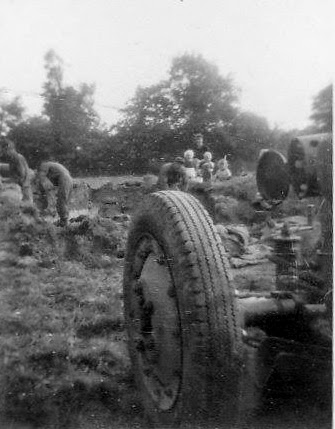
"Digging a gun position."


If you look carefully behind the tire, you can see what appear to be
French children and adults watching the American soldiers.

"40 mm dug in and ready for action." 


Some of the photographs show the French countryside as the troops passed through.

 "Old French farmer chatting with the neighbors."


"Picture taken from the truck. Young French girl passing out cider to men in the trucks."


Lou must have been driving when he took pictures as his unit passed through some parts of France.  He simply wrote "bombed buildings"on the back of this picture.  The destruction in the cities and towns was horrific.


Other photos have no writing on the backs.  They don't need words.


Other photos Lou sent home show scenes of life in camp.

"I am holding a Jerry rifle. The coats and hats are captured sheepskins & are they warm."


"C-47s coming in with supplies."


 "This was taken on a 2-day rest. Each of us has a quart of captured cognac. Chadwick is squatting in the middle."


 "I am pinning a good conduct medal on my machine gunner."


Lou also sent pictures home of the soldiers of the Third Army playing baseball.  He made no mention of what the French citizens thought of this odd game.


I searched online to see if I could find any other mention of Lou's military service, but I couldn't.  Other than a few U.S. Census references to places he and his family had lived, I wasn't able to find out anything else about him that wasn't in the file folder from the estate sale, except for one website that had been updated recently.  It listed only his name, the date April 5, 2014, and the words IN MEMORY OF....


Thank you, Lou, for your service, and thank you for saving those war pictures so we could see a bit of your side of the story.  I'll find them a good home with some historians who will add them to the larger story of D-Day and the Liberation of France in 1944-1945.

Thursday, June 2, 2016

Frank Serratoni, California Watercolor Artist

Often an estate sale is a good place to find art supplies. And, it turns out, fine art.

Drawing and painting were common pastimes for members of the Greatest Generation; women and men alike took art classes. Sometimes they bought more sketchbooks, boxes of pastels and watercolors, canvases, art pencils and charcoal than they could ever use.


Sometimes they kept their own amateur artworks, which in turn showed up at their estate sale. 


At this morning's estate sale, I spotted a large stack of framed paintings that had obviously been done by someone who'd taken an art class 40 or 50 years ago.  I looked through them: a nicely-done still life showing a pitcher and some fruit; a slanting, doe-eyed, ragged cartoonish child standing next to a trash can in an alley; a gunmetal gray horse-shaped object in a field of various shades of green, straight out of the paint tube.

Tucked away in between the somewhat dubious results of Grandpa's art class, I spotted a large old picture frame that had definitely seen better days. 


The frame was pale distressed wood with an even more-distressed orange burlap center.  The back was a nightmare of crumbling brown paper and twisted hanger wire.


But the painting inside the old frame was definitely not executed in someone's art class.


I'm no art critic, but I didn't have to look long at the image to realize that someone knew what they were doing when they painted this picture. My mother was a very good amateur artist in her time, and she taught me a few things to look for in a good watercolor painting.  

One of the things Mom had said, was that anyone can put color on white paper, but a good watercolor artist knows how to control the color so that the unpainted white paper shows through in the completed image. This artist knew how to control the colors.


Frank Serratoni, the signature said.  

I bought the painting, brought it home, liberated it from the frame (where it was held in place by an aging, crumbling thick piece of corrugated cardboard that had been installed long before the time acid-free paper was readily available) and inspected it more closely.


This artist was no amateur! He was Frank Serratoni (1908-1970).

Frank Serratoni, my online search informed me, was born in Detroit, Michigan, studied art in Chicago, and was a well-known artist in the San Francisco Bay Area in the 1940s and 1950s.  In the late 1940s, Serratoni issued a series of twelve hand-colored lithographs of California cityscapes and landscapes, which you can still find for sale online today.

You could buy Serratoni's artworks in iconic San Francisco stores like the City of Paris department store and the Paul Elders bookstore.  And you could find Serratoni's work in at least one place outside The City: there are newspaper ads for Braverman's Furniture Store in San Anselmo in 1950, promoting buying art by Frank Serratoni as a Christmas gift.


"Landscapes of places you've seen, choice of six subjects so familiar you'll recognize the setting at one glance. Nicasio, Los Altos, Navarro River, Woodside, Mt. Diablo, Sonora...." 

I wonder if the painting I found today, originally came from one of those venerable stores? 
_______________________________________

Footnote: In my online searching, I found a blog post about the Grateful Dead that said that Jerry Garcia once lived in a house called The Chateau in Menlo Park, California, that had earlier belonged to Frank Serratoni. 
_______________________________________

Here's a short bio of Frank Serratoni: