Tuesday, July 30, 2013

Git Along, Little Sticky Fingers

I've written here in the past about the popularity of cowboy and Western Americana items in the 1950s and 1960s.  I've seen everything from cowboy toys to greeting cards, lunch boxes to cameras, and everything in between at estate sales.  They're quite popular with collectors.

But until recently, I hadn't seen the cowboy motif as found on the vintage breakfast table.  Then, a couple of weeks ago at an estate sale for an elderly French couple (who immigrated to North America before World War II), I spotted these table napkin holders:


For some reason, they were in the bathroom of the couple's house, next to a rather nondescript soap dish.  But I think they must have originally been in the breakfast nook or on the dining room table.  One is in the shape of a pony wearing a Western saddle and bridle; the other is in the shape of a buckboard wagon, laden with supplies. 


The pony's face is quite detailed.


And the holders are reversible, so that a child (or adult) on either side of the table could see the image.  (Come to think of it, you could also use them to hold incoming or outgoing mail.)

In attempting to look up the history of cowboy-themed housewares, I discovered that many movie and TV cowboys were sponsored by breakfast food companies.  For example:

Tom Mix: Ralston Purina
Hopalong Cassidy: Post Grape-Nuts
Gene Autry:  Sparkies (Quaker puffed cereals)
Roy Rogers:  Mother's Oats (Quaker)
Roy Rogers and Dale Evans:  Post Cereals


Small cowboy-themed prizes (tiny horses and riders, rings, trading cards) could be found inside 0r outside the boxes of cereal.  


I also came across this blog post, which describes some of the ways movie and TV heroes of the 1950s and early 1960s had tie-ins with breakfast cereals:

http://www.waybacktimes.com/trautman105cowboys.html

My research also led me to lists of Movie, Radio and TV Cowboy "codes" -- words to live by, from the heroes of the fictional west.  The Roy Rogers Riders Club rules were:

Be neat and clean.

Be courteous and polite.

Always obey your parents.

Protect the weak and help them.

Be brave, but never take chances.

Study hard and learn all you can.

Be kind to animals and care for them.

Eat all your food and never waste any.

Love God and go to Sunday School regularly.

Always respect our flag and our country.


"Eat all your food and never waste any."  (And wipe your fingers and your mouth before you leave the table.)
____

More cowboy codes are available here:

http://www.elvaquero.com/The_Cowboy_Code.htm


Sunday, July 28, 2013

Short Notes: Vintage Tablecloths, Vol. 2

In honor of summer, I thought I would share some closeup pictures of the designs on some vintage tablecloths and matching napkins I recently found (and subsequently sold on eBay -- I can't keep everything....)   If your dining room or breakfast nook needs a spot of color, consider adding a vintage tablecloth and some napkins to your collection. 

Patriotic hibiscus.

Another patriotic theme, this time with roses.


This one looks like it's asking to be taken on a picnic. 

Set of four napkins and a bridge (or other small) tablecloth.

Closeup of a vintage cloth napkin.

Closeup of a vintage tablecloth border.

Three vintage tablecloths.

Strawberries.


 There are lots of websites dedicated to vintage tablecloths.  Here are a couple:

http://www.thevintagetable.net/

http://www.rickrack.com/tc1.html


Monday, July 22, 2013

Gentlemen Prefer

I enjoy finding old magazines at estate sales.  By looking through them, I discover not only how times and tastes have changed, but also how magazine editorial policies have evolved over the years.  The editors are concerned, of course, with providing information ("content") and selling ads.  They gear the content to what they think the readers (and potential buyers) are interested in.

So it was with great interest that I landed on a stack of mid-century Sports Illustrated magazines at a recent estate sale.  What has changed, over the years, in the magazine's content?  Let's look at one issue, from January 28, 1957.


The cover is pretty typical for an American sports magazine of any era: it features major team sports, sports overseas, and so on.  The inside of the magazine reveals that then, as now, even though women read SI, it's pretty much aimed at men.  You still see ads for cars.


And ads that draw a dotted line between sleek styling, powerful engines, and pretty girls.

  
One feature story commanded the center of the magazine the week of January 28, 1957.  The editors must have thought it was pretty important:


The New York Empire Cat Club Show.  No "swimsuit issue" here.  Real men like cats.


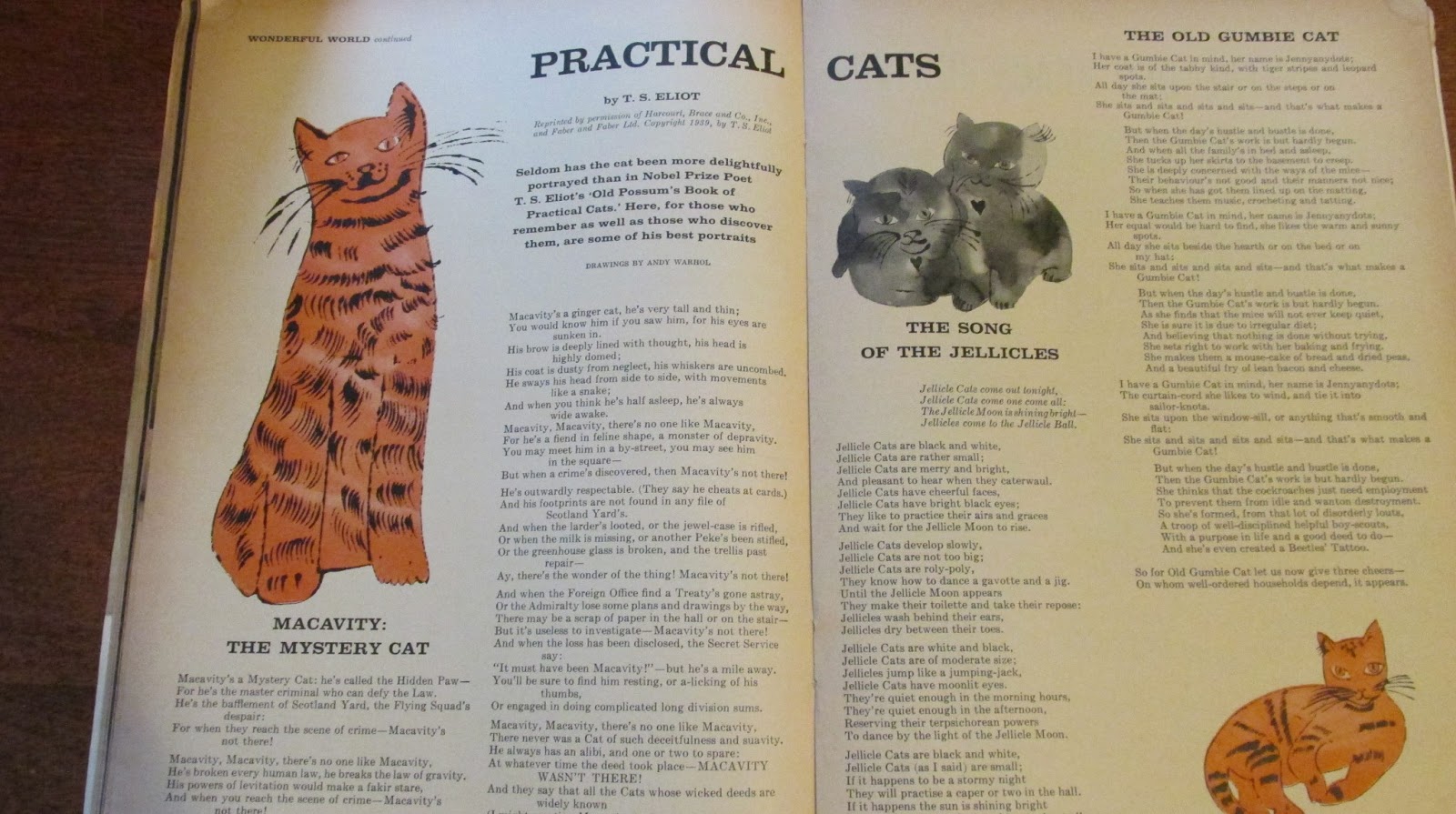
And, to give the story context, the following two pages were devoted to literature and art:


The two-page spread featured poems by T.S. Eliot (originally written in the 1930s) and illustrations by Andy Warhol (first published elsewhere in the 1950s).  Now there's a Jeopardy question for you:  What major publication featured the work of T.S. Eliot and Andy Warhol, in January 1957?


Warhol's "Green Sam," repurposed as "Macavity"
by Sports Illustrated.


Answer:  Sports Illustrated.
_____

You can find copies of Eliot's Old Possum's Book of Practical Cats everywhere.  I recommend the version illustrated by Edward Gorey.

Warhol published a book of cat drawings in 1954, called 25 Cats Named Sam and One Blue Pussy.  It was reprinted as Cats, Cats, Cats in 1994.


Sunday, July 21, 2013

The Avenger of Waterloo

Their names were Henriette and Auguste.  They originally came from France, but came to the US through Montreal and apparently lived most of their adult lives here.  They were alive during World War II, and when the war was over they returned to France to visit their cousins (the lady who owned the estate sale company told me).

One of the photographs in their collection caught my eye, so I bought it and brought it home.  It's a small snapshot inside a clear plastic sleeve, with a caption written in tiny script on a separate scrap of paper: "Longchamp avec mes amis et mes gosses" -- "Longchamp with my friends and my kids" and the date 1950 Avril.    


The Hippodrome de Longchamp is a racetrack outside Paris.  I'm not sure who the people are in the photograph, or how they were related to Henriette and Auguste.  They do look like they're enjoying themselves.  Maybe their horse won?

I think I recognize someone else in the photo, though -- the big guy in the background.  


That's the statue of Gladiateur, the legendary French race horse, at Longchamp.  Gladiateur won many major races in France and also in England, earning him the nickname "the avenger of Waterloo."  

The website Thoroughbred Heritage Portraits notes:

Gladiateur was a particularly large foal, with, it was reported by French writers, superb symmetry. A later English turf writer, possibly after he had trounced British horses on their own turf to take the English Triple Crown, described him as "a rough-looking, angular horse, without any quality." It was agreed he was tall: "amongst his Derby competitors, he stood out like a giant in the midst of pigmies." A later English turf writer said he had "strength, grace, sweetness and courage." 

I like that: Strength, grace, sweetness and courage.  Statues of us may never enhance famous race courses, but we humans would do well to try to show those characteristics too.

Here's a photograph of Gladiateur:


You can read more about him here:

http://www.tbheritage.com/Portraits/Gladiateur.html 

http://www.grimshaworigin.org/HarryJemmyGw.htm


Thursday, July 18, 2013

Plum

When I spotted it at the crowded estate sale, I greeted it like the old friend that it was.

"Plum!" I cried, removing it from the shelf.


The woman standing next to me gave me a disdainful look and sniffed.   She had observed that the item I held in my hand was not a piece of fruit at all.  It was a book. 


This book is titled "Something New" in the US.  In the UK, it's called "Something Fresh."  
It dates back to 1915. 
"Plum" was the nickname of the British author Pelham (say it quickly) Grenville Wodehouse ("wood-house" is close enough).  I first encountered his work indirectly, through Masterpiece Theatre on PBS, where TV versions of some of the Jeeves and Wooster stories were broadcast.  Then-host Alistair Cooke commented that Wodehouse (born 1881, died 1975) was considered by some to be the finest English-language writer of the 20th century.  But, Cooke observed, many scholars would never come right out and say so, because Wodehouse wrote funny stories, and that didn't seem -- well -- very scholarly.

It was one of those still evenings you get in the summer, when you can hear a snail clear its throat a mile away.

I enjoy finding hardback copies of old books at estate sales.  Recently, I've found two by Wodehouse.  If you're not familiar with him, but enjoy a good old-fashioned story, well-told, I encourage you to find a copy of a Wodehouse book and dive in.

No blog post can even come close to doing justice to the massive collection of stories P.G. Wodehouse left behind.  To me, the beauty of Wodehouse's writing is his ability to select just the right string of words.  He builds layer upon layer of narrative and plot like a Dagwood sandwich, and then skewers it in place gently with something that makes you chuckle.  Or snort.  Or burst out laughing.  Wodehouse doesn't tell us that his character "appeared sad and disgusted."  Rather:

He had the look of one who had drunk the cup of life and found a dead beetle at the bottom.

Or grumpy:  

I could see that, if not actually disgruntled, he was far from being gruntled.


A Wodehouse character feels trepidation:

Into the face of the young man who sat on the terrace of the Hotel Magnifique at Cannes there had crept a look of furtive shame, the shifty hangdog look which announces that an Englishman is about to speak French.

Or triumph:

She looked at me like someone who has just solved the crossword puzzle with a shrewd ‘Emu’ in the top right hand corner.

His characters make astute observations about one another:

She looked as if she had been poured into her clothes and had forgotten to say 'when.'

She had a penetrating sort of laugh. Rather like a train going into a tunnel.


Writers who struggle to find just the right descriptive phrase might do well to abandon their thesaurus and study Wodehouse instead.  A dog, in the hands of Wodehouse, doesn't merely growl:

The Aberdeen terrier gave me an unpleasant look and said something under his breath in Gaelic.

The best tribute to Wodehouse I've ever read is by British national treasure (and actor) Stephen Fry:  http://www.pgwodehousebooks.com/fry.htm  Fry gives his thoughts on why P.G. Wodehouse was a great author and, significantly, why we still need his stories.

I found this copy of a Wodehouse book at a "boot sale" (yard sale) in London.
If you're not familiar with Wodehouse yet, you might start by reading a collection of his short stories about Mr. Mulliner.  Mr. Mulliner frequents a pub called the Anglers' Rest.  Most of the other patrons of the pub are what they drink:  the Gin-and-Ginger-Ale, the Draught Stout, the Lemon Squash, the Small Bass.  Mr. Mulliner eavesdrops on their conversation, hijacks it, and recounts a story about one of his family members.  The other patrons of the pub always listen, and the story is always worth it:

...People who enjoyed a merely superficial acquaintance with my nephew Archibald (said Mr. Mulliner) were accustomed to set him down as just an ordinary pinheaded young man.  It was only when they came to know him better that they discovered their mistake.  Then they realized that his pinheadedness, so far from being ordinary, was exceptional.  Even at the Drones Club, where the average intellect is not high, it was often said of Archibald that, had his brain been constructed of silk, he would have been hard put to it to find sufficient material to make a canary a pair of cami-knickers....

If you're up for a longer work, try The Luck of the Bodkins, Carry On, Jeeves (one of the famous Jeeves and Wooster stories), or Summer Lightning (which takes place at Blandings Castle, home of Lord Emsworth, his dysfunctional but mostly-loving family, the castle's staff, and Emsworth's  prize-winning pet pig, The Empress of Blandings).

The Guardian (UK) newspaper states:

Recommended works

Wodehouse published over a hundred books, most of which are still in print. Among the best Jeeves and Wooster novels and collections are The Code of the Woosters and Joy in the Morning, while the finest Emsworth books include Summer Lightning and Heavy Weather. Two early novels worth exploring are Mike and Psmith in the City, while Ukridge and Uncle Fred in the Springtime features another of Wodehouse's best-loved characters, Stanley Featherstonehaugh Ukridge (pronounced Fanshawe Ewkridge). For an airbrushed but nonetheless fascinating glimpse of the man himself see the autobiographical Performing Flea and Over Seventy.

(The Guardian's observation about Ukridge is a good example of why Wodehouse is often funnier in print than when he is adapted for radio, TV or film.)

I think the best way to experience P.G. Wodehouse's genius is to find a used hardback copy of one of his works.  Set aside some time, relax and enjoy the experience.  If you can't find a good old hardback copy, a paperback will do.  

A paperback edition of three of the "Blandings Castle" stories, found at an estate sale.

Free online copies of Wodehouse's books and short stories abound online.  Project Gutenberg has many:
http://www.gutenberg.org/ebooks/author/783

Wodehouse's stories have been adapted countless times for film, radio and television, including  a recent BBC production, Blandings, which we've yet to see in the US.  Episodes of Jeeves and Wooster, produced by Granada Television and starring Stephen Fry and Hugh Laurie, are all over the Internet.  Here's one:
http://www.youtube.com/watch?v=WCisicEAsz8


Saturday, July 13, 2013

Short Notes: Vintage Tablecloth, Vol. 1


It's interesting to go to estate sales and see the things people have treasured.  Often, I find vintage textiles like this Startex (brand) tablecloth.  Its design shows a variety of collectible items -- a horse figurine, bowls, lamps, vases, bowls, even a duck decoy.


I thought it was pretty, so I brought it home.  Unfortunately it doesn't fit any of the tables in my house, so I'll list it on eBay and see if anyone else wants to use it to brighten their home (or their crafts project).  

Hope you enjoyed seeing the pictures!


Wednesday, July 10, 2013

From Gift Wrap to Outer Space

The colorful gift wrap with the freesia floral motif on a black background was inside a box with a bunch of other wrapping paper at the estate sale.


No one had ever used this paper.


In fact, the tag was still on it.


The tag read:
Hy-Sil Mfg. Co. 
Revere, Mass.


I'd heard of gift wrap makers like Hallmark and Norcross before, but not Hy-Sil.  So I went online and discovered that the company had a 100-year history.   

A Revere, Massachusetts local newspaper article claimed that Hy-Sil popularized gift wrapping paper before the start of World War I.


http://www.reverejournal.com/2012/11/14/wrapping-it-up-after-100-years-hysil-is-closing/


Three families, who comprised the Hy-Sil owners, began manufacturing leather post cards in Boston in 1903, and soon after introduced the world to gift-wrapping paper. When their business took off, they opened their Revere factory in 1912....

The Atlantic magazine claims, however, that Hallmark was responsible for making gift wrap available in America:  


http://www.theatlantic.com/technology/archive/2012/12/wrappers-delight-a-brief-history-of-wrapping-paper/266599/


Regardless of which company introduced gift wrapping paper to gift-givers in the 20th century, Hy-Sil had a powerful impact, locally and globally.  Beyond globally, really.  The local paper continues:

The company employed thousands of Revere and Chelsea residents, both full and part time. They made paper products and even invented some groundbreaking materials. Richard Silverman (the ‘Sil’ in Hy-Sil) actually invented Mylar – the silvery material that many character balloons are made of. That material was not only used for balloons, but also was used by NASA astronauts in space. It is used in countless products today.

Among the other innovations developed at the Revere factory were tinsel ribbon, metalized ribbons and wrapping foil. It also was the first American manufacturer to develop a process for depositing metal under vacuum conditions onto plastic films – a process that was used in the making of gift wrap but soon realized its own worth for use in solar window films.

Hy-Sil eventually became part of American Greetings, but the name stayed on as a party supply store until a few months ago, when the doors finally closed.

From leather postcards to lovely gift wrapping paper to tinted windows to outer space. That's a good long legacy.