Monday, February 29, 2016

Snow White and the Handsome King


When you think about Walt Disney's classic animated feature fim Snow White and the Seven Dwarfs, what images come to mind?

Snow White. Check.
Dwarfs. Check.
Evil Queen. Check.
Huntsman. Check.
Cute Animals. Check.
Handsome Prince. Check.
Handsome King.

Pause. What "handsome king"?

Many months ago, I wrote a blog post about finding a vintage original program from the 1937 premiere of Snow White in Los Angeles. On the cover was a montage of all the main characters, including the Handsome King.

Do you see him?


No?

Okay, scroll down a little bit. 


There he is. The horse who served as the model for the Prince's steed was the Arabian stallion King John.


King John was one of a number of Arabian horses owned by cereal magnate W.K. Kellogg in the 1930s. Kellogg kept his large herd of Arabians at his ranch outside Los Angeles. Hollywood celebrities visited often and had their pictures taken at the stables. King John was one of several Kellogg horses that ended up in the movies. 

Actually, King John's life story sounds not unlike the plot of a film. Foaled in the desert, King John was taken to Cairo where he was a polo pony and later a race horse. He was imported to the U.S. in 1929, where he had a career as a show horse.

The W.K. Kellogg Arabian Horse Library's Facebook page notes:

[King John] was sold to the W.K. Kellogg Arabian Horse Ranch in 1931. King John appeared in many Hollywood films, such as "The Scarlett Empress" (1934), "Lives of a Bengal Lancer" (1935), "The Garden of Allah" (1936), and "Suez" (1938), alongside famous actors and actresses like Marlene Dietrich, Gary Cooper, Tyrone Power, and Loretta Young. 


King John and Marlene Dietrich.

As well-known and well-loved as he was, King John sometimes took a publicity back seat to other horses from the Kellogg Ranch. The most famous of the Kellogg Ranch movie horses was Jadaan, ridden by silent film icon Rudolph Valentino in The Son of the Sheik.  King John was listed as the stablemate of another Kellogg Arabian, Pep, in this April 1932 clipping from the Chino Champion newspaper. 


You may have noticed that the artist's rendition of King John and the other characters from Snow White don't look quite like the ones in the animated film. That's because they were drawn by concept artist and children's book illustrator Gustaf Tenggren. The website Filmic Light, source of All Things Snow White, tells Tenggren's story:

http://filmic-light.blogspot.com/2011/02/closer-look-at-tenggrens-snow-white.html

A YouTube user has cobbled together several classic film scenes that show Arabian horses. Some of the film clips are from The Garden of Allah, Lives of a Bengal Lancer, and Son of the Sheik.  (The latter features another Kellogg Arabian of the same era, Jadaan, ridden by Rudolph Valentino.)

https://www.youtube.com/watch?v=1aO-o2uoA5s

King John spent many years at Kellogg's Arabian horse farm. And in October 1941, the city of Redlands, California, presented him with an appreciative resolution. The San Bernardino County Sun noted:

Now 19 years old, King John once was acclaimed the fastest horse in Egypt, where he was bred by desert tribesmen... His beauty and intelligence have earned great prominence....


King John died in 1946 at age 24. He's buried near the Rose Garden on the campus of Cal Poly Pomona.

http://www.cpp.edu/~library/specialcollections/history/rosegarden.html

And I have donated my copy of the original Snow White program to the W.K. Kellogg Arabian Horse Library, to complement their archive of printed and photographic materials on King John, his travels and his career.

https://www.cpp.edu/~library/kellogg-arabian-horse-library/index.shtml

_______________________________________

Sidebar: You may not think you've ever seen Tenggren's art before, but you probably have, if you were born after about 1942. After he left Disney, Gustaf Tenggren illustrated many more children's books, including The Poky Little Puppy.


Here's a copy of my original blog post about the 1937 Snow White premiere program:

http://estatesalechronicles.blogspot.com/2014/12/repostingoriginal-1937-snow-white.html


Friday, February 19, 2016

Nearly Lost Los Angeles Football History: The LA Dons


Much has been said in recent weeks about the return of the NFL’s Rams from St. Louis to Los Angeles, and the potential for the Chargers to move to LA from San Diego. One of the big questions being asked was (and is) whether LA could support – or would even “need” – two professional football teams.

The dialogue about the Rams and the Chargers is interesting. But I was even more interested to find a small scrap of paper at an estate sale this week that alerted me to the fact that this wouldn’t have been the first time Los Angeles had two professional football teams sharing a stadium.

That scrap of paper was a December 1946 ticket stub that I found tucked away inside a 1947 Rose Bowl program.  It was underneath a ticket from the Rose Bowl game.


Before I looked inside the Rose Bowl program, I’d had no idea that, 70 years ago, LA not only had the Rams…it had the Dons.


The stub told me that on December 1, 1946, the Los Angeles Dons played the Buffalo Bisons. I'd never heard of the Los Angeles Dons. I hadn’t heard of the Buffalo Bisons either. (An odd name for a team. Still, I suppose that sounds better than calling them the Buffalo Buffalo.)

By doing some quick online research, I discovered that the Los Angeles Dons were a professional football team in the now defunct All-America Football Conference (AAFC) from 1946 to 1949, that played in the LA Memorial Coliseum on the USC campus.  That was long before my time, and decades before I moved to this area.

It turns out that the Dons were the first professional football team to play a regular season game in LA, two weeks before the rival Los Angeles Rams of the National Football League played their first game in LA. The Dons’ financial backers included no less than film magnate Louis B. Mayer and actors Bob Hope, Bing Crosby, and Don Ameche.

A quick check of a pro football website told me that the Dons won that game against Buffalo. Actually, they didn’t just win – they trampled the Bisons, 62-14.


But that game was one highlight in the LA Dons’ otherwise mediocre history.

Ten years ago, the Los Angeles Times recalled the first game the Dons played in the All-America Football Conference.


The LA Times reported:

The AAFC helped open the West Coast to pro sports and brought long-lasting innovations, such as widespread air travel, extensive use of zone defenses and 14-game schedules, the latter not adopted by the NFL until the 1960s….

The Dons were….unable to top their 7-5-2 record in that first season and finishing with a four-year mark of 25-27-2. But in three of their four seasons they outdrew the Rams, who touched down in Southern California as the defending NFL champions.

So what happened to the Los Angeles Dons, that hardly anyone remembers them today?  The LA Times remembered that, despite their popularity, the Dons and the AAFC were the victims of a salary war:

In 1947, the Dons drew a then-pro-record 82,576 to the Coliseum for a game against the New York Yankees, and in 1948 they outdrew every NFL team.  But after 1949 they and the AAFC faded into obscurity, victims of a salary war that at the time was called the most expensive in sports history, draining millions of dollars from owners in both leagues.


Wikipedia says that the Dons merged with the Rams after their 1949 season. But even though the Los Angeles Dons are now just a footnote in football history, one of their players left a more lasting legacy. Bill Radovich, who played both offense and defense, left the NFL's Detroit Lions to play for the LA Dons in 1947. There was no free agency back then, no players' union. 

The Lions objected; Radovich claimed they had threatened to put him on a blacklist for five years if he didn't stay in Detroit. Radovich went to LA anyway, and filed a lawsuit against the NFL. The case went all the way to the US Supreme Court. Several years ago, the Chicago Tribune reported on the story in depth:


Last year, the website LA Curbed posted some photos of from the LA Dons’ brief history.


Saturday, February 13, 2016

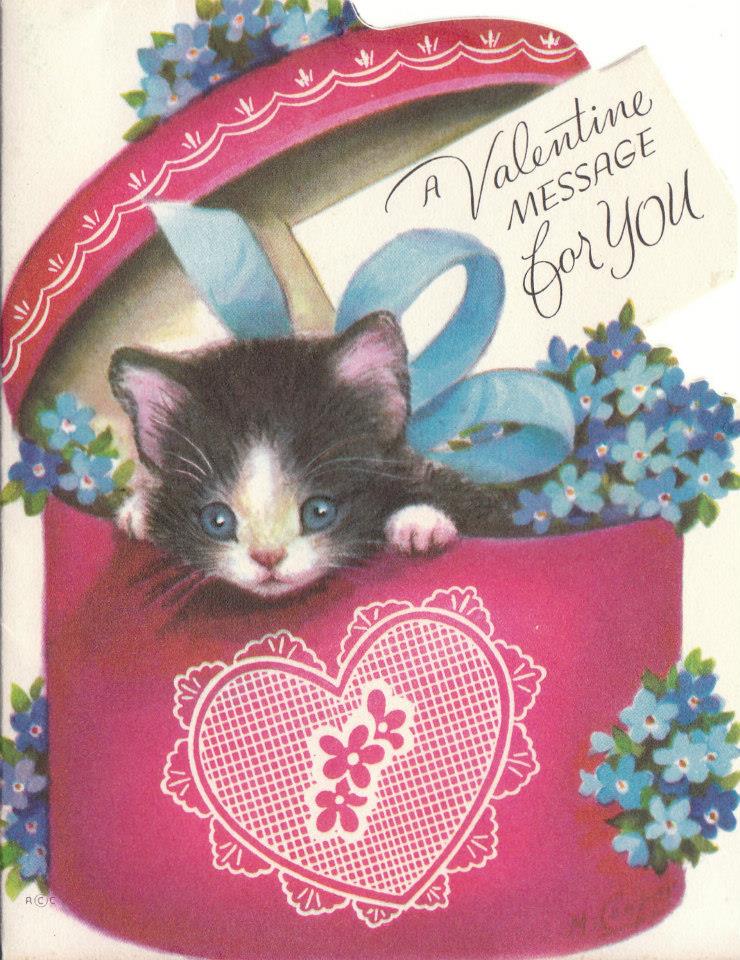
Norma and the Norcross Kittens


With Valentine's Day upon us this weekend, it's time to bring out some more mid-century paper ephemera in celebration.

I've written before about the massive amount of Cat Stuff I saw at the estate sale last year of a woman named Norma. Norma saved her paper collection in large scrapbooks; I brought home a few of them. Many of the cards had dates as well as signatures. Most were from the late 1940s to about 1965.

It's not uncommon for people (okay, women) to save greeting cards from their childhood. Perhaps her mother stuck the cards carefully into a baby book, and the girl continued the tradition when she got older with additional scrapbooks to hold special cards from family and friends.


Norma's early cards, obviously intended to be sent to a child, were signed "Love, Mother and Daddy." 


Others came from her sister Margie and Margie's friend Helen.  


Looking at the sheer volume of dozens and dozens of kitty-themed Valentines in Norma's collection dated between the 1940s and the 1960s, I realized that either a) Norma had a very long childhood, or b) her friends and family knew that she just liked to receive cute kitten cards.

I looked up Norma's obituary; she had been a teacher and then a school administrator all her adult life. So b) above must have been the answer: the grown-up Norma still collected cat cards.


Good for Norma. Her hobby (obsession?) allows us to see examples of mid-century art, and to remember a day when a holiday was marked not with a quick text message or e-mail, but a greeting card, thoughtfully selected, tucked into an envelope, addressed and mailed, then carefully saved by the recipient.

Many of the kitty cards Norma and her sister Margie saved were by the Norcross company. A quick search of the Newspapers.com website shows that Norcross did a lot of advertising in the mid-20th century, to promote their various card lines.

And Norcross' kitten cards were among their most popular. 


The kittens also appeared on gift wrapping paper.


At least three of the Norcross kitten designs had names. That's Snowball, above.  

This is Topaz.


And the third named kitten, Inky, was featured in many Norcross newspaper ads.


Don't laugh derisively at the Norcross Kittens. The archives of the Norcross company, including far more cards than Norma and Margie ever amassed, are in no less a place than the Smithsonian Institution in Washington, DC.  The Smithsonian provides a bit of company history:

Arthur D. Norcross founded the Norcross Greeting Card Company in New York City in the nineteen twenties. From the start Norcross cards had a "look" which contributed to their selling success although, through the years, the company commanded only a small share of the greeting card market. In 1974 the company relocated to West Chester and Exton, Pennsylvania, where in 1981 Norcross and the Rust Craft Greeting Card Company merged to form divisions of a parent company.


The Smithsonian also provides us with some context:

According to Norcross Company officials in 1978, this collection represents "not only a history of the development of the greeting card industry but also a history of social trends in the United States" and gives "an indication of the quality and technology of the [printing] industry from 1924 through 1978." 

Here are more some of Norma's cat-themed Valentines, by Norcross, Rust Craft, Hallmark and other makers. Enjoy. 

And do give someone a Valentine's Day card this year. Preferably a paper one.


_________________________________________________________________________

You can read the history of the Norcross company in the Smithsonian Institution's PDF, here:

http://amhistory.si.edu/archives/AC0058.pdf

The blog Vintage Recycling provides more information on Inky the Norcross Kitten:

http://vintagerecycling.blogspot.com/2013/09/1940s-inky-irresistible-norcross-kitten.html


Monday, January 25, 2016

Great-Aunt Adelia and the Doctor of Applesauce

My friend and relative Betty's great-aunt Adelia was a career woman in a time when most women didn't have (or keep) careers. She worked in Los Angeles as the private secretary to one of California's most influential attorneys and civic leaders in the first half of the 20th century, Henry W. O'Melveny. A very bright young man, he grew up in Los Angeles in the mid-1800s and was witness to the city's exponential growth. O'Melveny attended UC Berkeley, became a prominent lawyer, and helped establish both the California Institute of Technology and UCLA.

Here's Mr. O'Melveny, with his large mustache and twinkling eyes. 


And here's Great Aunt Adelia. She's the one with her hand on Mrs. O'Melveny's shoulder at a garden party at the O'Melveny's westside LA home. 


These photos came from Great-Aunt Adelia's estate; Betty inherited them from another relative. I visited Betty a few days ago, so I could look at Great-Aunt Adelia's photos and papers and perhaps identify an archive or archives to receive them. And indeed the papers and photos need to be in the hands of professional archivists and historians, for they're full of Los Angeles history.

Some of the photographs have writing on the back, but not all of them. Betty and I puzzled over this one, blank on the back. 


We can see Mr. O'Melveny on the left side, standing next to one of the most recognizable and beloved Americans of all time, the humorist, radio and film star, newspaper columnist, and all-around "cowboy philosopher" Will Rogers. 

He looks a bit more down-to-earth than the other men. The picture reminded me of the story of when a university wanted to give Will Rogers an honorary degree. Rogers cabled the editor of the Daily Oklahoman newspaper that he considered honorary degrees to be "hooey" -- 

"I got too much respect for people that work and earn 'em, to see 'em handed around to every notorious character." 

Rogers added that his kindergarten could award him the only honorary degree he wanted -- a D.A. (Doctor of Applesauce). "Applesauce," in the early 1900s, meant "nonsense." People took Rogers' "nonsense" very seriously, though, because often truth lay under the surface of the humor.


But who were the other men in the picture? And what event brought them all together? (The man holding the cowboy hat in one hand and a folder in the other looked oddly familiar to me, but I didn't think too much about it at the time.) 

I found the answers to those questions from a most unexpected source, only three days after Betty gave me the picture. 

Regular readers of this blog will know that I love horses, and often write about horse figurines and books when I find them at estate sales.  Last week I also made a visit to the Arabian Horse Library at Cal Poly University in Southern California,to do some research.

The Arabian Horse Library at Cal Poly Pomona is named for W.K. Kellogg of cereal fame, who had purchased a large parcel of land outside Los Angeles in 1925 and established a world-famous Arabian horse ranch on it.  The W.K. Kellogg Arabian Horse Center website remembers:


The ranch became so popular that a show was established on Sundays in order to better showcase the Arabian horses.  W.K. Kellogg presented the ranch to the state of California in 1932 with the stipulation that the Arabian breeding program and the Sunday Shows be maintained.


The library staff members were professional, courteous, and encouraging. The first book they showed me was Mary Jane Parkinson's The Romance of the Kellogg Ranch, a massive, detailed narrative with lots of great pictures. (I was so impressed by the book, I bought a copy to bring home.)


You can imagine my surprise when I opened the book to a random page and saw, not an Arabian horse --


-- but a copy of the same photograph Adelia had saved for her boss! 

My questions were answered. The event was that 1932 presentation ceremony when W. K. Kellogg gifted his 750-acre ranch, 87 horses, and an endowment fund to support them, to the University of California. After serving as a US Army Remount Center during World War II, the Kellogg Ranch property eventually became the home of California State Polytechnic University Pomona, better known as Cal Poly Pomona.

Parkinson's book told me that Will Rogers, a great lover of horses who emceed the event, was standing next to California governor James "Sunny Jim" Rolph (the former mayor of San Francisco). The man with his hat in his hand was W. K. Kellogg himself.  Adelia's boss, Henry O'Melveny on the left in the photo, gave a speech in his role as chair of the state parks commission. 


However, the pictures convey nothing of the scale of the event. The organizers knew the transfer of the ranch was big news. The Kellogg Ranch had expanded the bleachers at its horse show ring to hold 4,000 people; they expected perhaps 3,000 to attend.

But an estimated 25,000 people packed in for the event on that day in May 1932. Parkinson's book says that the bleachers, the rooftops, and the hillsides were packed with Southern Californians who wanted to see Will Rogers and the other celebrities (including the Arabian horses). Police estimated that an additional 10,000 people were turned away as they tried to drive in. 


I wonder if Betty's Great-Aunt Adelia was part of that huge crowd?

The Covina Argus newpaper reported:

Arrival at the area of Capt. William Banning's six-in-hand Concord coach, bearing Governor Rolph, Mr. Kellogg, Will Rogers, screen star and master of ceremonies, and others, brought a great ovation from the crowd, and [there was] an official salute from [a] three-inch salute gun brought here from headquarters of the 160th Infantry in Los Angeles.

The event also included a horse show, two bands, and a 17-gun salute. Six film news weeklies, several newspapers, and four national press services covered it; NBC installed a phone line to the ranch to provide live radio coverage. 


Great-Aunt Adelia had saved another, different picture from the same event in her collection.  In it, you can see Will Rogers standing behind half a dozen huge microphones, and Henry O'Melveny with his large mustache in the lower right corner, clearly enjoying himself.


A few days later, Rogers wrote about the event in his weekly syndicated newspaper column:

"Well I had a fine time here about ten days ago. I went with our Governor, Jimmy Rolph, and we, 'We' accepted in behalf of the State of California, one of the most magnificent ranches you ever saw. It comprises about seven hundred acres.

"Course that don’t sound so big, but that’s land that is all piped and watered, and irrigated, and improved. It is the largest Arabian Horse Ranch in America. It has 87 head of pure breed Arabian horses, the most wonderful up to date stables and equipment you ever saw. It’s a marvelous place, about 40 miles out of Los Angeles, near Pomona. It was given to the State University Department of Animal Husbandry, and will be maintained by them. 

"It was the gift of W. K. Kellogg of Battle Creek. He has been coming out here for the winters for several years and built up this beautiful place. We had a big ceremony.

"Mr. and Mrs. Kellogg turned over the deeds to the Governor. They are mighty fine, plain, wholesome folks, the Kelloggs....

"So these horses are really American and not Arabian. They also have another American characteristic, they are long winded. 

"There is a Senator among every colt born."


After  I finished my research in the Library, I went down the street to meet some of the people who work at the W. K. Kellogg Arabian Horse Center, and some of their current crop of wonderful horses. They, too, are "mighty fine," wholesome folks.


Update: Adelia's collection has been donated to Cal Poly Pomona's Special Collections library, where it will help inform scholars, students and the general public about life in Southern California. 
______________________________________________________________________

Here's a link to the history of Cal Poly Pomona:
http://www.cpp.edu/~aboutcpp/heritage/index.shtml

Here's a link to the W.K. Kellogg Arabian Horse Library website:
http://www.cpp.edu/~library/kellogg-arabian-horse-library/

And the Arabian Horse Center:
http://www.wkkelloggarabianhorsecenter.com/

Here's information on Will Rogers:
http://www.cmgww.com/historic/rogers/

And here's information on Henry O'Melveny:
http://www.omm.com/aboutus/history/


Tuesday, December 22, 2015

Reposting:1937 Snow White Film Premiere Program

This post originally appeared in 2014. I'm reposting it for the anniversary of the debut of the film!

Program for Disney's Snow White Premiere: December 21, 1937

It was a very important moment in the history of film: the premiere of the first feature-length animated film. Walt Disney's  Snow White and the Seven Dwarfs was first screened the night of December 21, 1937, at the Carthay Circle Theatre in Los Angeles.


Someone -- I don't know who -- went to the event and brought home a copy of the program for that night.  


I found it at an estate sale the other day. It was stacked in a dusty garage with a bunch of old magazines.  

This program was a witness to film history, so I was very careful as I handled it to take pictures to show you here.


The program is in good shape for being over 75 years old.  The inside centerfold is printed on silver foil:


Other pages provide facts about the film, interspersed with congratulatory ads from local businesses and others in the film industry.


Walt Disney wrote a note of thanks to his staff.


A massive marketing campaign accompanied the debut of the film. I. Magnin & Co.'s ad in the opening night program showcased Cartier's 14k gold Snow White bracelet, a narrow gold link chain with charms representing Snow White and all seven dwarfs.  Cost: $100.  Suggestion: Christmas gift.


The program gave the history of the story of Snow White, a "paragon of girlish virtue" in Disney's version of the tale.


There were several ads for local businesses.  This one is for the Melody Lane, "the most beautiful cafe' in Los Angeles."


There was a page in the program devoted to the music of Snow White and the Seven Dwarfs.  


And more congratulatory ads from local businesses.  It must have been tricky to print on silver foil.


Technicolor took out a full-page ad.


I wasn't able to find out the name of the person who went to the premiere of Snow White, on that December night so long ago.  Tickets were notoriously hard to come by.  Did the original owner of the program work for Walt Disney, or know someone who did?  She or he must have been aware, at some level, that the premiere was making history.  

In retrospect, we know that making Snow White was a massive gamble for Walt Disney.  There had never been a feature-length animated film before this one.  It cost a fortune to make; production took three years and the talents of 750 artists.  Hollywood gossips called it "Disney's folly." America was still reeling from the shock of the Great Depression.  Would people pay to see a full-length cartoon?  Would the dark themes in the film be considered too frightening for children to see?

The build-up to the premiere was intense. The 1500 tickets sold out quickly; the audience included Hollywood luminaries from Shirley Temple to Cary Grant to Charlie Chaplin.  Several hundred Disney animators who worked on the film bought tickets so they could see how the finished product came out.

It was reported that more than 3o,000 people who couldn't get tickets for the premiere packed the streets anyway, just to be part of the event and get tickets for later showings.  Bleachers were set up to accommodate them, and extra police were brought in for security.

The premiere of Snow White was accompanied by a number of special exhibits and activities. One was the outdoor "Dwarfland" diorama created along Wilshire Boulevard, a couple of blocks from the Carthay Circle Theatre.  It featured actors dressed as the Seven Dwarfs, complete with cottage, a working water wheel, and diamond mine.

Here's a YouTube video clip of the premiere event: 

 https://www.youtube.com/watch?v=ILBw0sz0Ahc


There are several blogs dedicated to All Vintage Things Disney.  Perhaps the most comprehensive source for information on the premiere of Snow White is the blog Filmic-Light.  Here's its report, complete with lots of pictures, on the premiere:


http://filmic-light.blogspot.com/2012/12/75th-anniversary-of-snow-whites-world.html


Snow White and the Seven Dwarfs lived up to, even exceeded, its hype. The History.com website summarizes:

The stunning success of “Snow White” marked a turning point in the career of Walt Disney, and established him among the world’s most celebrated filmmakers. The quality of its animation, voiceover work and musical score set a high standard for all future animated features made by Disney or any other studio. 

And the old program I found at an estate sale, was there at the premiere.

(Yes, I know.  This original program needs to be in the hands of a real collector of vintage Disney. I'm sure one will come forward, once I post this piece on the blog.)
_________________________________________

Additional resources:


Filmic-Light (above) also has a Facebook page that features Snow White memorabilia.

Here are more web pages related to the premiere of "Snow White and the Seven Dwarfs:"

http://vintagedisneymemorabilia.blogspot.com/search/label/Snow%20White


http://decidedlydisney.blogspot.co.uk/2012/12/snow-at-christmas.html

The Disney Family  Museum website tells about the opening:
http://www.waltdisney.org/storyboard/snow-white-and-seven-dwarfs-opening


As does the official Disneyland blog:


http://disneyparks.disney.go.com/blog/2011/12/opening-night-1937-snow-white-and-the-seven-dwarfs-premieres-at-carthay-circle-theatre/


Sidebar: I remember that my mother did a dandy impersonation of Snow White singing, "I'm wishing {echo: I'm wishing} / For the one I love...." and "Someday My Prince Will Come." Mom was a little girl when the film first came out, so she had plenty of time to practice her coloratura voice before her kids were born. "Whistle While You Work" and "Hi-Ho" were easier to remember, though.