Thursday, June 2, 2016

Frank Serratoni, California Watercolor Artist

Often an estate sale is a good place to find art supplies. And, it turns out, fine art.

Drawing and painting were common pastimes for members of the Greatest Generation; women and men alike took art classes. Sometimes they bought more sketchbooks, boxes of pastels and watercolors, canvases, art pencils and charcoal than they could ever use.


Sometimes they kept their own amateur artworks, which in turn showed up at their estate sale. 


At this morning's estate sale, I spotted a large stack of framed paintings that had obviously been done by someone who'd taken an art class 40 or 50 years ago.  I looked through them: a nicely-done still life showing a pitcher and some fruit; a slanting, doe-eyed, ragged cartoonish child standing next to a trash can in an alley; a gunmetal gray horse-shaped object in a field of various shades of green, straight out of the paint tube.

Tucked away in between the somewhat dubious results of Grandpa's art class, I spotted a large old picture frame that had definitely seen better days. 


The frame was pale distressed wood with an even more-distressed orange burlap center.  The back was a nightmare of crumbling brown paper and twisted hanger wire.


But the painting inside the old frame was definitely not executed in someone's art class.


I'm no art critic, but I didn't have to look long at the image to realize that someone knew what they were doing when they painted this picture. My mother was a very good amateur artist in her time, and she taught me a few things to look for in a good watercolor painting.  

One of the things Mom had said, was that anyone can put color on white paper, but a good watercolor artist knows how to control the color so that the unpainted white paper shows through in the completed image. This artist knew how to control the colors.


Frank Serratoni, the signature said.  

I bought the painting, brought it home, liberated it from the frame (where it was held in place by an aging, crumbling thick piece of corrugated cardboard that had been installed long before the time acid-free paper was readily available) and inspected it more closely.


This artist was no amateur! He was Frank Serratoni (1908-1970).

Frank Serratoni, my online search informed me, was born in Detroit, Michigan, studied art in Chicago, and was a well-known artist in the San Francisco Bay Area in the 1940s and 1950s.  In the late 1940s, Serratoni issued a series of twelve hand-colored lithographs of California cityscapes and landscapes, which you can still find for sale online today.

You could buy Serratoni's artworks in iconic San Francisco stores like the City of Paris department store and the Paul Elders bookstore.  And you could find Serratoni's work in at least one place outside The City: there are newspaper ads for Braverman's Furniture Store in San Anselmo in 1950, promoting buying art by Frank Serratoni as a Christmas gift.


"Landscapes of places you've seen, choice of six subjects so familiar you'll recognize the setting at one glance. Nicasio, Los Altos, Navarro River, Woodside, Mt. Diablo, Sonora...." 

I wonder if the painting I found today, originally came from one of those venerable stores? 
_______________________________________

Footnote: In my online searching, I found a blog post about the Grateful Dead that said that Jerry Garcia once lived in a house called The Chateau in Menlo Park, California, that had earlier belonged to Frank Serratoni. 
_______________________________________

Here's a short bio of Frank Serratoni:


Saturday, April 23, 2016

From the New England Kitchen of Heloise Frost


I probably bring too many things made of paper home from estate sales.  But paper is one of the ways we record important things; paper helps tell the story of our lives.

Case in point: a small box of greeting cards I picked up at a sale earlier this year. 

The box is labeled

NEW ENGLAND 
NOTES
with
Traditional Recipes

From the New England Kitchen
of Heloise Frost


 Inside was a set of blank greeting cards. 


And a set of different recipes, one for each card.


You fold a recipe and tuck it into a slot cut into the front of the blank card.


The inside of the card opens to reveal a space to write a personal note.

  
I suspect these cards date back to the early 1950s. That's when a couple of cookbooks were published under the name of Heloise Frost.  One was called Early American Recipes and the other, A World of Good Eating.

I wasn't able to find out anything about Heloise Frost, save that she was a New England author who lived in an 1809 house in New Hampshire. (She was not the same "Heloise" who's famous for writing a syndicated newspaper household advice column, Hints from Heloise.)

The illustrations for Early American Recipes were by another New Englander, artist Barbara Corrigan, and it appears that the designs on my vintage greeting cards were by Corrigan as well.  She was a well-known and respected New England artist, who illustrated books and also drew for the children's magazine Highlights.

Here are some of the recipes from the greeting card set.


I don't have a copy of either of Heloise Frost's cookbooks, but their legacy lives on, online.  Cookbook collector The Culinary Cellar has blogged about her:

http://theculinarycellar.com/a-world-of-food-from-a-1950s-new-england-kitchen/

Copies of Frost's two books are readily available from online sellers, from $5 to $50 and more.

Here's an article on artist Barbara Corrigan:

http://www.thesunchronicle.com/go/ahead-of-her-time/article_3efbb2f6-e901-5ab8-b1b1-f6bf0fa0ed3b.html


Wednesday, April 13, 2016

Remembering Peggy Fortnum and Paddington Bear

Another legendary children's book illustrator has passed away. Peggy Fortnum, who along with author Michael Bond, first brought Paddington Bear to life in the book series, died recently at the age of 96.  

I hope you were fortunate enough to have read the Paddington books when you were a child. If not, find them and read them today. 

Here's the Guardian's obituary of Peggy Fortnum, with lots of pictures:

http://www.theguardian.com/artanddesign/2016/apr/04/peggy-fortnum-obituary

And here's my original blog post about Paddington, from 2014.


Finding Paddington

Whenever I visit London, the very first thing I do is stop to say hello to an old friend.  

We take the train from Heathrow Airport to Paddington Station, and then I find the statue of Paddington Bear.  I sit with him for a moment while I collect my thoughts, and watch parents bring small children by to pat his nose and take pictures with him.

Statue of Paddington Bear, Paddington Station,
London, England, Europe, The World

I hope you're already familiar with Paddington, the beloved small brown bear from Darkest Peru, portrayed in a series of books by author Michael Bond.  (I won't call them "children's books" because the best children's books are really for grownups too.)  If not, I think you'll enjoy them.

I first met Paddington and his gentle adventures as a child, when my mom read the stories to us aloud.  Mom, a child of the radio drama age, really knew how to read aloud: she took her time, did all the voices, and showed us the pictures as they appeared in the text.  

Mr. Gruber and Paddington share cocoa for their elevenses,
in More About Paddington.  Illustration by Peggy Fortnum.


Bond, a cameraman at the BBC, was inspired to write the first story,A Bear Called Paddington, after he bought a small plush bear left alone on a shelf at Selfridge's department store as a last-minute Christmas present for his wife. His story became the first Paddington book, published in 1958.

The Paddington.com website has archived an interview with Michael Bond, who said:

"The great advantage of having a bear as a central character is that he can combine the innocence of a child with the sophistication of an adult...

"He gets involved in everyday situations. He has a strong sense of right and wrong and doesn't take kindly to the red tape bureaucracy of the sillier rules and regulations with which we humans surround ourselves. As a bear he gets away with things. Paddington is humanised, but he couldn't possibly be 'human'. It just wouldn't work."
The website also notes:
The Paddington books have sold more than thirty-five million copies worldwide and have been translated into over forty languages, including Latin.
In 1997 Michael Bond was awarded an OBE for services to children’s literature. He is still writing and lives in London, not far from Paddington Station where it all began.

Even though the books are loved by millions of children and people who used to be children around the world, many more first met Paddington as a plush toy.  Paddington.com reports:

The very first Paddington bear soft toy was designed in the UK by a lady called Shirley Clarkson. She made it as a Christmas present for her children, Joanna and Jeremy Clarkson (who was to go on to become a world famous motoring journalist). So many people admired Shirley’s Paddington that she started to make some more until her company, Gabrielle Designs and was granted an official licence to sell them in the UK in 1972....

[Top Gear's Jeremy Clarkson and Paddington Bear.  Now there's an odd couple, personality-wise.]

...Meanwhile, Paddington’s popularity was beginning to grow outside the UK and in 1975 the US company Eden Toys acquired the licence to make and sell Paddington bears throughout the rest of the world.

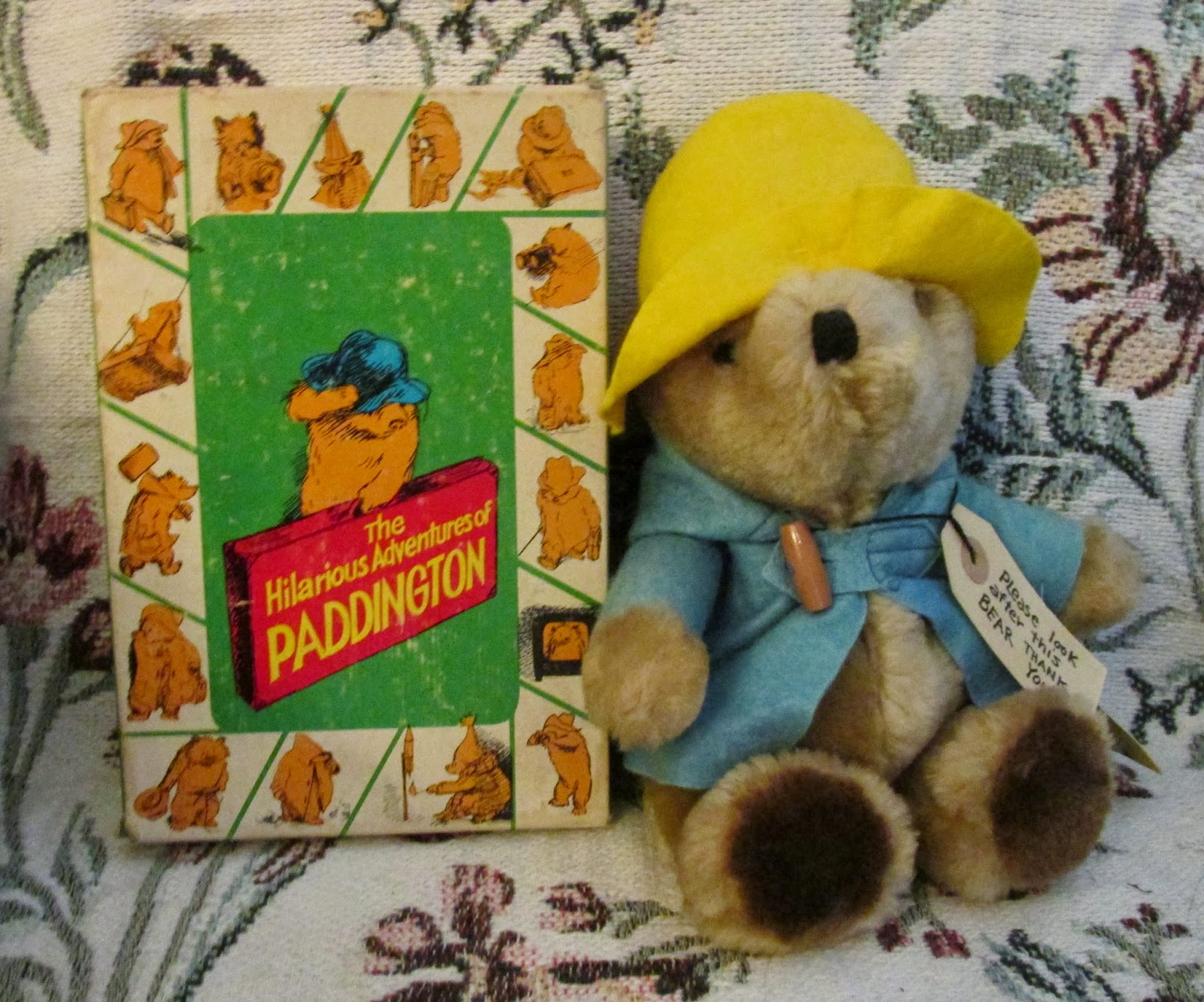
There have been dozens of other licensed Paddington items since then.  Every so often I find a plush Paddington Bear at an estate sale, in gently-loved condition. Here's a plush version of Paddington created by Eden Toys:


At another estate sale, I found a boxed set of paperback Paddington books.


Paddington's  appearance has morphed several times over the years, but to my mind the way he originally looked is still the best.  The illustrations by Peggy Fortnum perfectly complement the gentle nature of the original stories.  Here's another example from More About Paddington:


You can see what a very small bear Paddington was:


In this chapter, Paddington has never before experienced Christmas in England, and the Brown family members are concerned that he might try to play Father Christmas by coming down their chimney.


As you may have heard, Paddington has been made into a major motion picture for this holiday season, starring some of Britain's greatest actors (Hugh Bonneville, Peter Capaldi, Julie Walters and Jim Broadbent, for starters) as the humans in the story.  

I think the best way to first experience Paddington is to read the book, or even better, have someone read it to you.  The chapters in the books lend themselves nicely to reading each story a bit at a time.

You don't know someone who would read aloud to you? Here's a link to a nice long audio sample of the inimitable Stephen Fry reading a passage from A Bear Called Paddington:
http://www.learnoutloud.com/Catalog/Literature/European-Classics/A-Bear-Called-Paddington/23142

_________________________________________

Here's a link to the movie section of the official Paddington website: http://www.paddington.com/gb/the-movie/

Paddington has starred in several different versions of his story in the UK.  You can watch some of Paddington's adventures on YouTube.  Stop-motion:
https://www.youtube.com/watch?v=0cD0rtuWpso&index=18&list=PLWJa48pm3noa-CVm1nZMEZUHcQTH795Pm

And animated:
https://www.youtube.com/watch?v=SzxJ3mqIFAE

Monday, February 29, 2016

Snow White and the Handsome King


When you think about Walt Disney's classic animated feature fim Snow White and the Seven Dwarfs, what images come to mind?

Snow White. Check.
Dwarfs. Check.
Evil Queen. Check.
Huntsman. Check.
Cute Animals. Check.
Handsome Prince. Check.
Handsome King.

Pause. What "handsome king"?

Many months ago, I wrote a blog post about finding a vintage original program from the 1937 premiere of Snow White in Los Angeles. On the cover was a montage of all the main characters, including the Handsome King.

Do you see him?


No?

Okay, scroll down a little bit. 


There he is. The horse who served as the model for the Prince's steed was the Arabian stallion King John.


King John was one of a number of Arabian horses owned by cereal magnate W.K. Kellogg in the 1930s. Kellogg kept his large herd of Arabians at his ranch outside Los Angeles. Hollywood celebrities visited often and had their pictures taken at the stables. King John was one of several Kellogg horses that ended up in the movies. 

Actually, King John's life story sounds not unlike the plot of a film. Foaled in the desert, King John was taken to Cairo where he was a polo pony and later a race horse. He was imported to the U.S. in 1929, where he had a career as a show horse.

The W.K. Kellogg Arabian Horse Library's Facebook page notes:

[King John] was sold to the W.K. Kellogg Arabian Horse Ranch in 1931. King John appeared in many Hollywood films, such as "The Scarlett Empress" (1934), "Lives of a Bengal Lancer" (1935), "The Garden of Allah" (1936), and "Suez" (1938), alongside famous actors and actresses like Marlene Dietrich, Gary Cooper, Tyrone Power, and Loretta Young. 


King John and Marlene Dietrich.

As well-known and well-loved as he was, King John sometimes took a publicity back seat to other horses from the Kellogg Ranch. The most famous of the Kellogg Ranch movie horses was Jadaan, ridden by silent film icon Rudolph Valentino in The Son of the Sheik.  King John was listed as the stablemate of another Kellogg Arabian, Pep, in this April 1932 clipping from the Chino Champion newspaper. 


You may have noticed that the artist's rendition of King John and the other characters from Snow White don't look quite like the ones in the animated film. That's because they were drawn by concept artist and children's book illustrator Gustaf Tenggren. The website Filmic Light, source of All Things Snow White, tells Tenggren's story:

http://filmic-light.blogspot.com/2011/02/closer-look-at-tenggrens-snow-white.html

A YouTube user has cobbled together several classic film scenes that show Arabian horses. Some of the film clips are from The Garden of Allah, Lives of a Bengal Lancer, and Son of the Sheik.  (The latter features another Kellogg Arabian of the same era, Jadaan, ridden by Rudolph Valentino.)

https://www.youtube.com/watch?v=1aO-o2uoA5s

King John spent many years at Kellogg's Arabian horse farm. And in October 1941, the city of Redlands, California, presented him with an appreciative resolution. The San Bernardino County Sun noted:

Now 19 years old, King John once was acclaimed the fastest horse in Egypt, where he was bred by desert tribesmen... His beauty and intelligence have earned great prominence....


King John died in 1946 at age 24. He's buried near the Rose Garden on the campus of Cal Poly Pomona.

http://www.cpp.edu/~library/specialcollections/history/rosegarden.html

And I have donated my copy of the original Snow White program to the W.K. Kellogg Arabian Horse Library, to complement their archive of printed and photographic materials on King John, his travels and his career.

https://www.cpp.edu/~library/kellogg-arabian-horse-library/index.shtml

_______________________________________

Sidebar: You may not think you've ever seen Tenggren's art before, but you probably have, if you were born after about 1942. After he left Disney, Gustaf Tenggren illustrated many more children's books, including The Poky Little Puppy.


Here's a copy of my original blog post about the 1937 Snow White premiere program:

http://estatesalechronicles.blogspot.com/2014/12/repostingoriginal-1937-snow-white.html


Friday, February 19, 2016

Nearly Lost Los Angeles Football History: The LA Dons


Much has been said in recent weeks about the return of the NFL’s Rams from St. Louis to Los Angeles, and the potential for the Chargers to move to LA from San Diego. One of the big questions being asked was (and is) whether LA could support – or would even “need” – two professional football teams.

The dialogue about the Rams and the Chargers is interesting. But I was even more interested to find a small scrap of paper at an estate sale this week that alerted me to the fact that this wouldn’t have been the first time Los Angeles had two professional football teams sharing a stadium.

That scrap of paper was a December 1946 ticket stub that I found tucked away inside a 1947 Rose Bowl program.  It was underneath a ticket from the Rose Bowl game.


Before I looked inside the Rose Bowl program, I’d had no idea that, 70 years ago, LA not only had the Rams…it had the Dons.


The stub told me that on December 1, 1946, the Los Angeles Dons played the Buffalo Bisons. I'd never heard of the Los Angeles Dons. I hadn’t heard of the Buffalo Bisons either. (An odd name for a team. Still, I suppose that sounds better than calling them the Buffalo Buffalo.)

By doing some quick online research, I discovered that the Los Angeles Dons were a professional football team in the now defunct All-America Football Conference (AAFC) from 1946 to 1949, that played in the LA Memorial Coliseum on the USC campus.  That was long before my time, and decades before I moved to this area.

It turns out that the Dons were the first professional football team to play a regular season game in LA, two weeks before the rival Los Angeles Rams of the National Football League played their first game in LA. The Dons’ financial backers included no less than film magnate Louis B. Mayer and actors Bob Hope, Bing Crosby, and Don Ameche.

A quick check of a pro football website told me that the Dons won that game against Buffalo. Actually, they didn’t just win – they trampled the Bisons, 62-14.


But that game was one highlight in the LA Dons’ otherwise mediocre history.

Ten years ago, the Los Angeles Times recalled the first game the Dons played in the All-America Football Conference.


The LA Times reported:

The AAFC helped open the West Coast to pro sports and brought long-lasting innovations, such as widespread air travel, extensive use of zone defenses and 14-game schedules, the latter not adopted by the NFL until the 1960s….

The Dons were….unable to top their 7-5-2 record in that first season and finishing with a four-year mark of 25-27-2. But in three of their four seasons they outdrew the Rams, who touched down in Southern California as the defending NFL champions.

So what happened to the Los Angeles Dons, that hardly anyone remembers them today?  The LA Times remembered that, despite their popularity, the Dons and the AAFC were the victims of a salary war:

In 1947, the Dons drew a then-pro-record 82,576 to the Coliseum for a game against the New York Yankees, and in 1948 they outdrew every NFL team.  But after 1949 they and the AAFC faded into obscurity, victims of a salary war that at the time was called the most expensive in sports history, draining millions of dollars from owners in both leagues.


Wikipedia says that the Dons merged with the Rams after their 1949 season. But even though the Los Angeles Dons are now just a footnote in football history, one of their players left a more lasting legacy. Bill Radovich, who played both offense and defense, left the NFL's Detroit Lions to play for the LA Dons in 1947. There was no free agency back then, no players' union. 

The Lions objected; Radovich claimed they had threatened to put him on a blacklist for five years if he didn't stay in Detroit. Radovich went to LA anyway, and filed a lawsuit against the NFL. The case went all the way to the US Supreme Court. Several years ago, the Chicago Tribune reported on the story in depth:


Last year, the website LA Curbed posted some photos of from the LA Dons’ brief history.


Saturday, February 13, 2016

Norma and the Norcross Kittens


With Valentine's Day upon us this weekend, it's time to bring out some more mid-century paper ephemera in celebration.

I've written before about the massive amount of Cat Stuff I saw at the estate sale last year of a woman named Norma. Norma saved her paper collection in large scrapbooks; I brought home a few of them. Many of the cards had dates as well as signatures. Most were from the late 1940s to about 1965.

It's not uncommon for people (okay, women) to save greeting cards from their childhood. Perhaps her mother stuck the cards carefully into a baby book, and the girl continued the tradition when she got older with additional scrapbooks to hold special cards from family and friends.


Norma's early cards, obviously intended to be sent to a child, were signed "Love, Mother and Daddy." 


Others came from her sister Margie and Margie's friend Helen.  


Looking at the sheer volume of dozens and dozens of kitty-themed Valentines in Norma's collection dated between the 1940s and the 1960s, I realized that either a) Norma had a very long childhood, or b) her friends and family knew that she just liked to receive cute kitten cards.

I looked up Norma's obituary; she had been a teacher and then a school administrator all her adult life. So b) above must have been the answer: the grown-up Norma still collected cat cards.


Good for Norma. Her hobby (obsession?) allows us to see examples of mid-century art, and to remember a day when a holiday was marked not with a quick text message or e-mail, but a greeting card, thoughtfully selected, tucked into an envelope, addressed and mailed, then carefully saved by the recipient.

Many of the kitty cards Norma and her sister Margie saved were by the Norcross company. A quick search of the Newspapers.com website shows that Norcross did a lot of advertising in the mid-20th century, to promote their various card lines.

And Norcross' kitten cards were among their most popular. 


The kittens also appeared on gift wrapping paper.


At least three of the Norcross kitten designs had names. That's Snowball, above.  

This is Topaz.


And the third named kitten, Inky, was featured in many Norcross newspaper ads.


Don't laugh derisively at the Norcross Kittens. The archives of the Norcross company, including far more cards than Norma and Margie ever amassed, are in no less a place than the Smithsonian Institution in Washington, DC.  The Smithsonian provides a bit of company history:

Arthur D. Norcross founded the Norcross Greeting Card Company in New York City in the nineteen twenties. From the start Norcross cards had a "look" which contributed to their selling success although, through the years, the company commanded only a small share of the greeting card market. In 1974 the company relocated to West Chester and Exton, Pennsylvania, where in 1981 Norcross and the Rust Craft Greeting Card Company merged to form divisions of a parent company.


The Smithsonian also provides us with some context:

According to Norcross Company officials in 1978, this collection represents "not only a history of the development of the greeting card industry but also a history of social trends in the United States" and gives "an indication of the quality and technology of the [printing] industry from 1924 through 1978." 

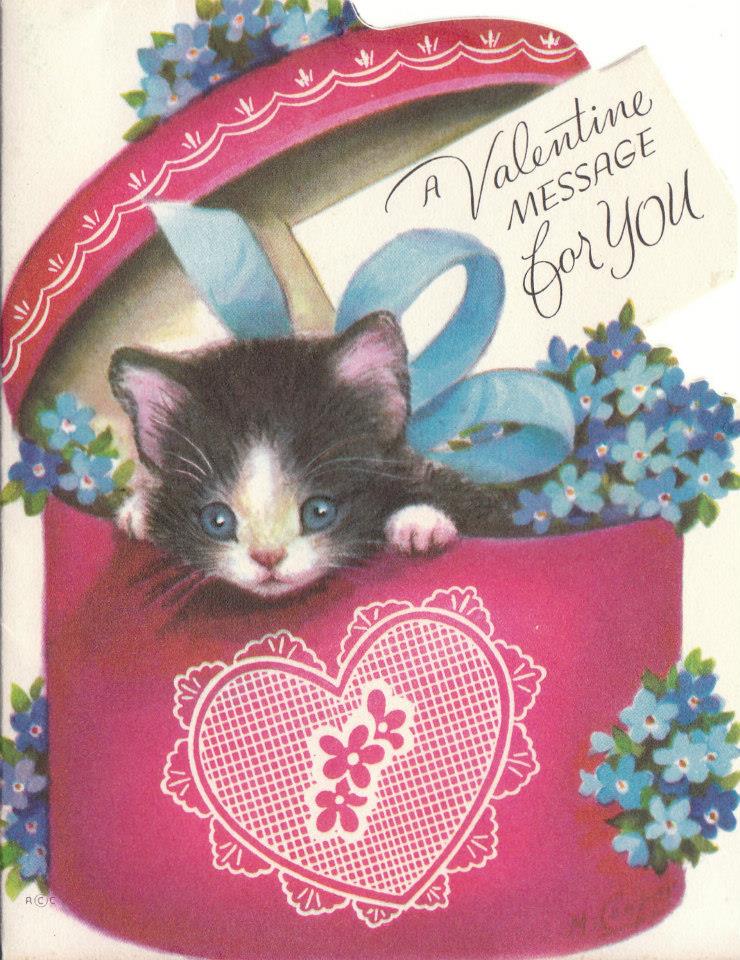
Here are more some of Norma's cat-themed Valentines, by Norcross, Rust Craft, Hallmark and other makers. Enjoy. 

And do give someone a Valentine's Day card this year. Preferably a paper one.


_________________________________________________________________________

You can read the history of the Norcross company in the Smithsonian Institution's PDF, here:

http://amhistory.si.edu/archives/AC0058.pdf

The blog Vintage Recycling provides more information on Inky the Norcross Kitten:

http://vintagerecycling.blogspot.com/2013/09/1940s-inky-irresistible-norcross-kitten.html