Tuesday, December 3, 2013

The 1956 Western Auto Christmas Catalog

In a previous post, I shared the cover of a 1956 Western Auto Christmas catalog that I found at an estate sale.  I thought it might be fun to share some of the pages inside the catalog as well. 


First, a little company history:

Western Auto Supply Company, Western Auto for short, was a chain of hundreds of retail stores founded in 1909 by George Pepperdine, who also founded Pepperdine University in Southern California.   

Throughout the year Western Auto offered automobile supplies and accessories.  At Christmastime, however, Western Auto's aisles were filled with everything from baby dolls to toy trains and so much more.

Let's check the mail from December 1956, and see what we might ask Santa to bring us for Christmas.  (Some of the pages are out of order, but we can still hopscotch down Memory Lane.)

First, a vinyl Bride Doll, Cindy Strutter Walking Doll, and Tiny Tears.


Betsy McCall cosmetics case, a child's tea set, a pink play stove and a jack-in-the-music box.


Boys' toys by Buddy-L, a Wyatt Earp double holster set, and a tiny piano.


 More dolls, and plush animals; doll carriages and more.


 More tea sets, and small appliances.


 Musical toys and furniture.


 Cootie, Sorry and other games.


Service station, toy phones, toy typewriters, and lots of sets for pretend jobs.


 Toys for little kids.


 Disney and other character toys.


The boys had been waiting to find their pages!  Metal farm sets, an Army Jeep, airplanes....


Outdoor toys.


Note the Dragnet police car.


Lots of TV cowboy toys.


 (The train under the tree was really for Dad, wasn't it?)


 "Robert" the Robot and other high-tech toys.


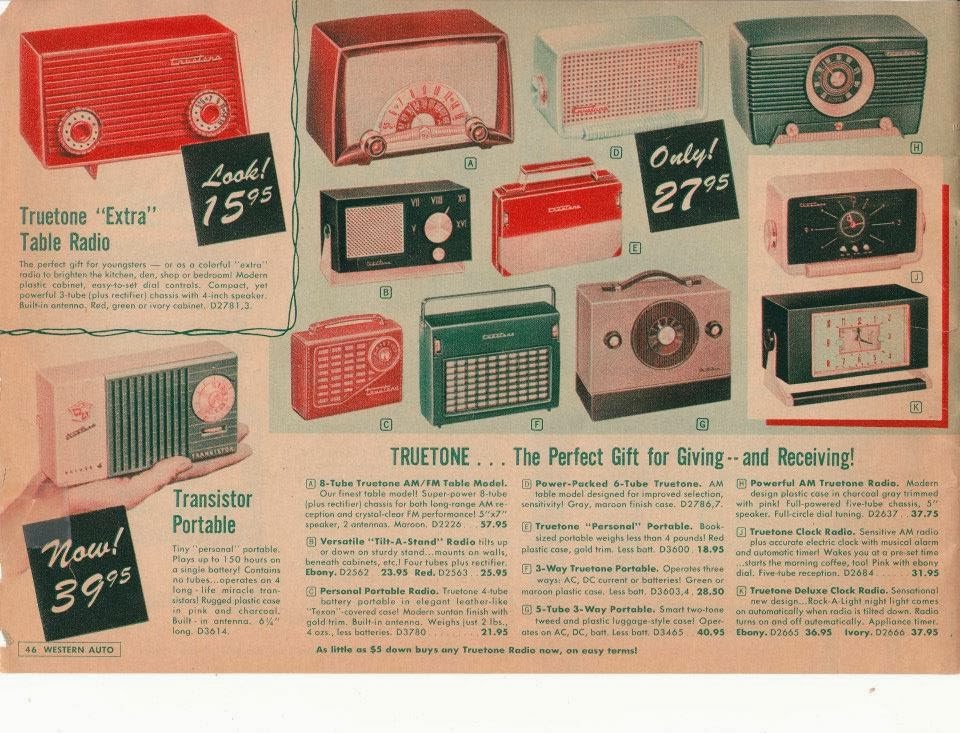
 Every kid should have his own radio station for Christmas.

More trains.


 Western Auto's house brand of bicycles.


Mickey Mouse and Roy and Dale watches.


More outdoor toys and accessories....


...including an air rifle for Ralphie.


And finally, we get to some gifts for older kids and for adults.


If you get Mom one of  these appliances, Dad, don't forget that she might like something else more romantic, too. 


 Gifts for the house.


Christmas decorations.


And, finally, the last page of the catalog, with hobby horses for the young equestrian in the family.

So what would you ask Santa to bring you, if you were enjoying Christmas in 1956?

A Ginny Doll for Christmas

I couldn't resist buying the 1956 Christmas catalogs from at an estate sale.  Someone had carefully saved them in a box with her other Christmas stuff.


In the 1950s, the Christmas season didn't start to arrive in mid-July, like it does today.  It started after Thanksgiving, heralded by the postman delivering Christmas catalogs to the family's home address.


Certainly there were ads on television, and ads on the radio, and ads in the newspaper and magazines at Christmastime.  But nothing quite compared with the arrival of the Christmas catalog.  Catalogs from Sears, Montgomery Wards, Western Auto, W.T. Grant, and regional stores like the May Company and Rex's in Southern California were passed from child to child to parent, to be pored over for hours on end.  (And no doubt Santa was watching the child's every move.)


No matter what its source, the Christmas catalog was filled with the stuff that a child's dreams were made of, in mid-century America.  
As I leafed carefully through the pages of the May Co. catalog (the paper was, after all, nearly 60 years old!), one page in particular caught my attention:  

Ginny.


I never had a Ginny doll, when I was a kid.  Her first heyday was a little before my time.  My friend Linda, who's a bit older than I am, remembers having a Ginny when she was a girl.  Ginny -- who predates Barbie by several years -- was made by an American toy manufacturer called Vogue.  


The Vogue Dolls website gives the official history of Ginny.  She was the creation of Jennie Adler Graves, who had begun making and selling doll clothing in the 1920s.  By the late 1940s, Graves had moved from dressing other makers' dolls to creating her own line:


  Success followed success until 1948, when a sales dip in her line of existing dolls inspired Mrs. Graves to introduce an 8" plastic doll, the forerunner to Ginny. Store owners and consumers alike loved the new doll, and in 1951, Ginny was officially born, named after Jennie's daughter Virginia. From a point in 1949 where a 15,000 square foot warehouse was needed and Vogue employed 50 regular workers plus from 100 to 200 home sewers and did a sales volume of $239,000 a year, Vogue grew to a point in 1953 where annual volume reached $2,113,904. Ginny's success was assured.
     Ginny was so popular that many tried to emulate her, and an entire group of 8" dolls appeared on the market in anticipation of securing some of the Vogue business and Ginny fans. By 1957, Ginny had reached over five million dollars per year in sales, and was a beloved fixture in most American households.

One of the hardest lessons to learn as a kid, is that you don't always get what you asked for at Christmas.  Sometimes your heart's desire is outside your parents' budget.  Sometimes your parents don't understand why you "have to have" that one special toy.  And so you wait.  


But take heart, young gift-seeker: it's never too late to find a nice old toy.  Just be patient.  When you're older, and no one else can tell you how to spend your disposable income, you can decide whether you still have to have that one special toy you wanted as a kid.


I know this because I found a whole grocery bag full of Ginnys and their clothes and shoes and accessories at another estate sale a few weeks ago.  The lady who bought one of them from me on eBay told me she's 60 years old and she's finally getting her Ginny doll.  

Just in time for Christmas.


(Yes, we'll look more closely at the insides of those old Christmas catalogs in future blog posts.  Stay tuned.)
___________________________________________

The website GinnyDoll.com has lots of information on collectible Ginny: her history, face and body types and more:


http://www.dollinfo.com/Ginny/ginnyhome.htm


Vogue Dolls is still in business; their website gives more on the history of Ginny, her family and friends:


http://www.voguedolls.com/History.htm

Thursday, November 28, 2013

Remembering Old Friends: Children's Books

Who read to you, when you were little?

I hope someone read aloud to you.  If they did, it's probably why you're a reader today.


My mother was not just a good reader-aloud, she was a great reader-aloud.  She was a child of the radio era, when technology was still pretty new and imagination was triggered by the spoken word.


When Mom read aloud to us, she did all the voices of the characters in the story.  And when I was old enough to read the book for myself, I read my favorite books over.  And over.  And over.  And over again, until I had whole passages memorized.


That's what I remembered when I found the big box of old children's books at the estate sale the other day.


I took one look at the cover of this book and heard the familiar words inside my head:  


"...Penny and Lenny and Salter and Pepper, Jolly and Rolly and Patch and Latch.... Spot and Dot and Blob [I always felt sorry for a puppy called "Blob"] and Blot and Blackie and Whitey and -- where's Lucky?"


I flipped the book open:


Bingo.  


I will not tell you how many years it had been since I'd seen the pages of this book, my friends.  Let's just say that The Beatles were probably on The Ed Sullivan Show in our living room at the time.  


And yet as soon as I saw this Little Golden Book, I recalled some of the text almost word for word.  

Bonding with Little Golden Books as a small child helped foster my lifelong love of literature.  When I was a little older, I read and enjoyed the original book The Hundred and One Dalmatians by Dodie Smith. Then as a teenager, I read Smith's classic novel I Capture the Castle.  

You see?  One good book leads to another.

I dug excitedly through the rest of the children's books at the estate sale and found some more that I'd once owned but had completely forgotten about -- until I saw them again.  I brought them home too.


A young adult relative was recently lamenting having to be a "grownup" at Christmastime.  My advice to him, as it is to you, is yes -- do grow up.  But cherish your good memories of childhood.  And when you have the chance, buy "new" old copies of the books from your childhood -- and read them again.  As C.S. Lewis wrote:


“No book is really worth reading at the age of ten which is not equally – and often far more – worth reading at the age of fifty and beyond.”


Then share your old books with another child, young or old.


Wednesday, November 27, 2013

The Tiny Thanksgiving Turkey

A cartoon has been circulating on the Internet for the last few days.  It shows a drawing of a Thanksgiving turkey, with the caption:

REMEMBER TO SET YOUR SCALES BACK 
TEN POUNDS 
THIS WEEK

I often see, but don't purchase, Thanksgiving and other harvest-themed decorations at estate sales.  I don't have enough space to store them in my smallish house, and the space I do have for display is usually displaying food, plates and serving utensils on major holidays.  

I made an exception to this rule a few weeks ago, however, when I found a metal turkey figurine.  It's a perfect trinket for someone trying to watch their weight during the holidays:


I have no idea what I'll do with Tiny Tommy Turkey.  Maybe I'll give him to someone I know who has a dollhouse display.  In the meantime, he can enjoy his 15 seconds of online fame.  

Happy Thanksgiving, everyone.

Tuesday, November 19, 2013

Wyandotte Pre-War Doll Carriage

The local vintage toy collectors and dealers show up at many of the estate sales I attend.   Old toys are collectible.  They remind people of their own childhood, and a lot of those toys were built to last.

A good example of this is the small pressed metal doll carriage or buggy I found at a neighbor's yard sale last weekend.  


It's about 10 inches long from stem to stern, including the handle.  I balanced it on my postal scale and it registered a hefty 1.5 pounds.  The bottom of buggy shows that it was made, probably in the 1930s (long before my time!) by the All Metal Products Company of Wyandotte, Michigan.  


The history of All Metal Products Company, better known to collectors nowadays simply as "Wyandotte," reflects many of the changes in America during the early to mid-20th century.  Because of those changes, the company reinvented itself several times during its many years in business.  

Apparently All Metal Products started out in the early 1920s making parts for automobiles, then shifted its focus to using scrap metal from the auto industry to create toy pistols and rifles.  

The company's motto at the time was "Every Boy Wants a Pop Gun."  This must have been more than a slogan, because by 1929 All Metal/Wyandotte was the world's largest maker of toy guns.  

But in late 1929, the stock market crashed, and All Metal/Wyandotte reinvented itself again, branching out into more and different toy designs: doll buggies (like the one I found), games, musical toys, and a large range of cars, trucks and wagons.  Their slogan changed to "Wyandotte Toys Are Good and Safe."  Arthur Edwards, the president of All Metal Products, became mayor of the city of Wyandotte in 1932 and died in office later that year, but the company continued to grow under the direction of Edwards' son Charles.  

The company's toys, mass-produced on an assembly line (the technique borrowed from the auto industry), were a) inexpensive and b) virtually indestructible -- two requisites during the Great Depression.  The website FabTinToys continues exploring the company's history:

Their simply built, streamlined, art deco steel cars and trucks were unmistakable. Through the years they built heavier gauge steel cars, distinguished by their baked enamel finish, and wooden wheels, they were designed to withstand the rigors of almost any young child's endless playing, as evidenced by the condition of the many Wyandotte toys treasured by today's collectors. 

Tin cars produced by the company are more rare and very few exist today. Things were developing nicely for the company, and it continued to grow. In 1936, they added lithographed novelty toys. In 1937, they introduced spring-driven motors to propel some of their vehicles. This in turn led to a wider range of wind-up and lever-action novelty toys.

Then, with the advent of World War II, All Metal Toys/Wyandotte was forced to change its focus again.  

The US government needed ships, tanks, planes and weapons for war, and that required massive amounts of metal.  Any metal -- including metal for toys -- was rationed.  Citizens took part in scrap metal drives, to collect metal for recycling for the war effort, and it's safe to say that a lot of the metal toys of the 1930s were scrapped in the war effort in the 1940s.   The toys were literally "all metal" no longer; Wyandotte turned to creations of wood and die-cut cardboard.  The company aided the war effort by making clips for the M-1 rifle.  

After the war, the company reinvented itself again.  The owners moved the factory to Ohio and merged with a company that made toy trains.  All Metal/Wyandotte also made a very successful line of cap pistols in the early 1950s, including official Hopalong Cassidy pistols and holsters.  

But the world was changing again.  Production costs and salaries at the unionized factory were high, and the Korean War created a steel shortage.   All Metal Products Company filed for bankruptcy protection in 1956, and its assets were liquidated in 1957.


Even though the company is gone, their toys are still with us.  I imagine the little girl who originally owned the doll buggy I found at the yard sale, could never have imagined the many changes that would come during her lifetime.
_________________________________________

Here's an article on Wyandotte from Toy Collector magazine:


The website FabTinToys has more on the history of Wyandotte/All Metal:


And blogger OldAntiqueToys has pictures of many wonderful Wyandotte metal cars:


Nichols Cap Guns has lots of pictures of the Hopalong Cassidy pistol sets: 


The National World War II Museum website explains more about the changes to life on the home front during the war:


The Wyandotte, MI website is here: